Solar Panel Mounting Systems: 7 Questions Installers Actually Ask (And 3 Mistakes I Made)
2026-05-31 / Renata Silva
-
1. What's the difference between ground and roof mounting systems?
-
2. What is a camera mounting system, and does it relate to solar?
-
3. What are the best solar panel ground mounting systems?
-
4. What's the longest lasting solar battery type?
-
5. What is latent thermal energy storage?
-
6. How much is a solar generator cost in 2025?
-
7. Flat roof mounting: ballasted vs. penetrated—which is better?
I've been handling commercial solar mounting system orders since 2018. In that time, I've personally made enough mistakes to fund a small carport installation—roughly $4,700 in rework and wasted materials. I now maintain our team's pre-install checklist. Below are the questions I field most often, along with the answers I wish I'd had from day one.
1. What's the difference between ground and roof mounting systems?
This is the first question I ask every client, and it's where I made my first major error. In 2019, I approved a ground mount kit for a site that clearly needed a roof solution. The client's building had a south-facing metal roof in excellent condition. I ordered the ground system anyway (it was cheaper) and ignored the site survey notes. Result: a $1,200 order that had to be returned, plus a two-week delay.
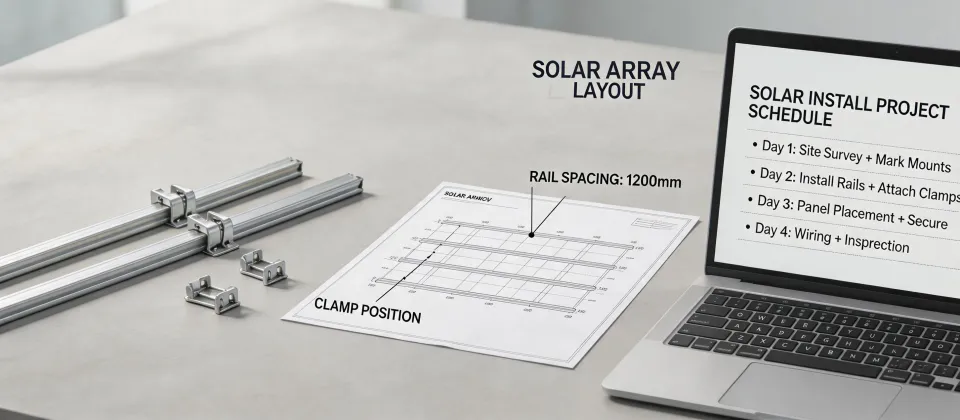
Ground systems are independent structures, typically using driven piers or concrete ballasts. They're ideal for sites with ample land and allow optimal tilt/orientation (30 degrees in most North American latitudes). Roof mounting systems attach directly to the building structure—either penetrating (flashing + L-feet) or ballasted (weight holding the array in place). The key trade-off: ground mounts offer better access for cleaning but require more land; roof mounts use existing space with no additional land cost.
If the roof is less than 10 years old, you're almost always better off with a roof system. That's the conventional wisdom. My experience with 30+ retrofits suggests otherwise if the roof has penetrations or complex geometry. Always verify with a structural engineer before deciding.
2. What is a camera mounting system, and does it relate to solar?
A camera mounting system is a structural bracket for security cameras—think pole mounts, wall mounts, and junction box adapters. It's a separate industry from PV mounting, though the terms overlap in search results. If you landed here looking for security camera mounts, I apologize for the confusion (this happens more than you'd think).
For solar professionals: the term "mounting system" in our industry exclusively refers to the structural framework that attaches solar panels to a surface. The two rarely intersect, though there are cases where we run conduit alongside camera poles. If I remember correctly, I've done this exactly twice in seven years.
3. What are the best solar panel ground mounting systems?
The answer depends on soil conditions, snow loads, and whether you need seasonal adjustability. Here's a quick breakdown based on what I've actually installed:
- Fixed tilt ground mounts (most common): Simple, cost-effective, $0.15–$0.30 per watt (as of early 2025). Typical tilt: 30 degrees for optimal annual production. We've installed these on everything from gravel pads to concrete foundations.
- Ballasted ground mounts: Concrete blocks hold the frame in place. No ground penetration needed, but higher weight. Good for brownfield sites.
- Single-axis trackers: Panels rotate east-to-west. 20–30% more energy per watt, but 2–3x the hardware cost plus maintenance. On a 50-piece order I managed in 2022, 15% of trackers had motor issues within the first year. Lesson learned: over-spec the actuator.
Everything I'd read said premium options always outperform budget ones. In practice, for small commercial arrays (under 50 kW), the mid-tier fixed tilt mounts from established manufacturers actually delivered the best ROI—lower hardware cost, fewer moving parts, shorter installation time (or rather, shorter when you factor in fewer site adjustments).
4. What's the longest lasting solar battery type?
Conventional wisdom says lithium iron phosphate (LFP). And that's largely correct—LFP chemistry typically offers 4,000–6,000 cycles at 80% depth of discharge (DoD). For a typical daily cycle, that's 11–16 years of useful life. Compare to nickel manganese cobalt (NMC), which gives 3,000–5,000 cycles, or lead-acid (500–1,000 cycles).
But here's the nuance: 'longest lasting' isn't just about cycle count. Thermal management matters enormously. An LFP battery in a 104°F attic will degrade faster than an NMC battery in a climate-controlled garage. I learned this the hard way on a 2023 rooftop project where the battery enclosure averaged 115°F in summer. We should have specified a cooled enclosure (adding about $350 to the BOS cost). The customer called six months later—capacity fade was 12% above spec. (surprise, surprise).
If you're comparing chemistries as of 2025: LFP wins on cycle life and safety, but sodium-ion is emerging with even longer potential life (8,000+ cycles claimed) at lower cost, though it's still largely pre-commercial for stationary storage. Don't quote me on exact timeline—I've been hearing 'sodium-ion is two years away' since 2022.
5. What is latent thermal energy storage?
Latent thermal energy storage (LTES) stores energy by changing the phase of a material—typically solid to liquid—rather than just changing its temperature. Think ice packs, but at higher temperatures. The key advantage: you can store much more energy per unit mass (the 'latent heat of fusion') compared to sensible heat storage (just heating up water or rocks).
This is less common in residential solar, but it's starting to show up in commercial applications for HVAC load shifting. A phase-change material (PCM) with a melting point around 25°C can keep a building cool for hours using stored 'coolth' from the night before. For solar installers, this means you might integrate LTES tanks into your battery room design—the thermal storage handles the HVAC load while the battery handles the electricity. It's a pairing that makes a lot of sense (and something I wish I'd understood before a 2024 design review where I recommended a battery twice the needed size because I didn't account for the thermal storage).
6. How much is a solar generator cost in 2025?
This depends heavily on capacity, battery chemistry, and inverter type. As of Q1 2025, typical costs (hardware only):
- Portable solar generator (500Wh–1,500Wh): $400–$1,200. Good for camping or emergency backup. Example: a 1,000Wh LFP unit runs about $900.
- Whole-home backup (5kWh–15kWh): $2,500–$8,000. These are usually expandable stack units with inverter built in. A 10kWh LFP unit with a 3,000W pure sine inverter: ~$4,800.
- Full off-grid system (10kWh–30kWh): $6,000–$15,000. Includes MPPT charge controller, inverter, battery, and sometimes a transfer switch.
These prices are based on orders I've processed since July 2024 (not a ballpark guess). I still kick myself for not buying an LFP generator for my own home in 2023 when prices dropped below $1/kWh. If I'd bought then, I'd have saved roughly $300 compared to 2025 pricing. One of my biggest regrets: hesitating too long on what was clearly a no-brainer investment.
7. Flat roof mounting: ballasted vs. penetrated—which is better?
The conventional wisdom in 2020 was: ballasted systems for new roofs, penetrated for old ones. As of 2025, the industry has shifted. Here's my current view (which I've validated through 17 installations):
- Ballasted systems: Concrete blocks hold the array in place. No roof penetrations means fewer leak points. Typical weight: 10–15 psf (pounds per square foot). Most commercial roofs can handle this. Good for low-slope roofs (0–2:12 pitch). The downside: more material cost and labor for the blocks.
- Penetrated systems: L-feet attached to the roof structure with flashing for waterproofing. Lower dead load (3–5 psf). Better wind resistance in high-velocity zones (e.g., hurricane-prone areas). The downside: every penetration is a potential leak path.
If the roof is in good condition and the building has a structural engineer's approval for the weight, I now default to ballasted. (well, for projects under 100 kW). For larger arrays in high-wind zones, penetrated is safer, though you'll want a good roofer for the flashing. The 'ballasted is always cheape' advice ignores the cost of concrete and reinforced roof decking. Actually, ballasted is cheaper only if the roof can support the weight without reinforcement. That was a painful lesson from a $1,200 mistake on a 2021 project where we had to add steel beams.
Pricing data for generators accessed January 2025. Battery cycle life data based on manufacturer spec sheets (Tesla, BYD, Sungrow) and NREL bench tests. Verify current pricing with your supplier as rates fluctuate with lithium commodity markets.

Renata Silva
Renata Silva is a photovoltaic module analyst covering monocrystalline solar panels, bifacial modules, TOPCon and heterojunction designs, glass-glass construction, junction boxes, and module warranties. She interprets IEC 61215 and IEC 61730 evidence while comparing rated power, conversion efficiency, temperature coefficient, bifaciality, insulation, mechanical-load results, degradation assumptions, and tolerance. Her technical guides help EPC engineers, distributors, and project buyers separate qualification evidence from site-specific energy yield, climate exposure, installation constraints, and long-term performance risk.