The 6-Step Checklist for Choosing Solar Mounting Systems (And Avoiding My $15,000 Mistake)
2026-06-25 / Renata Silva
-
Step 1: Stop Thinking It's Like a 'TV Mounting System'
-
Step 2: Match the Mount to the Roof (Not the Other Way Around)
-
Step 3: Always Plan for Battery Storage Compatibility
-
Step 4: Don't Forget Cleaning Access — Your Panels Will Need Maintenance
-
Step 5: Verify Electrical Accessories Are UL-Listed for the Mount
-
Step 6: Add a 'Not Suitable' Disclaimer to Your Quote (Yes, Seriously)
-
Common Mistakes to Watch For
When I first started ordering mounting systems for solar panels, I assumed it was like buying a TV mount. Pick a size, pick a color, done. Three rejected orders, a $15,000 tab, and a very angry project manager later… I learned the hard way.
This checklist is for anyone ordering mounting systems — installers, EPCs, even homeowners dipping into DIY. If you're dealing with flat roofs, pitched roofs, ground mounts, or carports with battery storage components, this is for you. I've documented every mistake so you don't have to. Here's the 6-step checklist.
Step 1: Stop Thinking It's Like a 'TV Mounting System'
I get it. The phrase mounting systems for solar panels sounds similar to tv mounting systems. But the difference? Solar mounts live outdoors for 25+ years, carry live wires, and hold glass panels in hurricane zones. A cheap TV bracket from Amazon won't cut it.
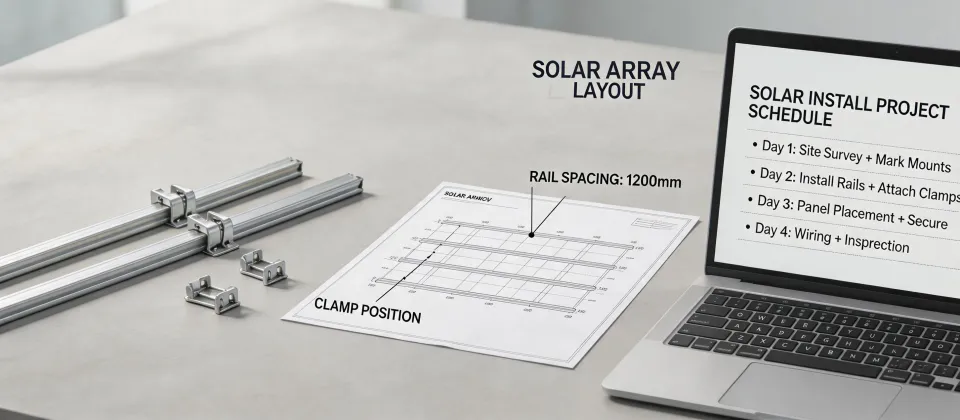
In my first year (2017), I ordered a batch of what I thought were standard aluminum rails. They looked fine on screen. The result? They bowed under the first snow load. 200 panels, $6,800 in rework. That's when I learned: solar mounting systems are structural — always check load ratings and applicable building codes.
Step 2: Match the Mount to the Roof (Not the Other Way Around)
This sounds obvious, but you'd be surprised how many orders I've seen where someone picks a ballasted flat roof system for a 45° pitched tile roof. It's a classic rookie mistake.
My lesson came in September 2022. I ordered a full penetrating ground mount system for a client who wanted a carport. We caught the error when the warehouse called asking for extra parts. $2,500 in shipping and restocking fees. Now I use a simple rule: flat roof? Ballasted or hybrid. Pitched roof? Rail-based or rail-less depending on tile type. Ground? Driven or concrete piers. Carport? Pre-engineered structural.
Honestly, the carport systems from companies like Mounting Systems are pretty well integrated — they even include electrical accessories like inverters and surge protectors as options. But you have to spec the right base.
Step 3: Always Plan for Battery Storage Compatibility
This one bit me in 2023. A customer wanted a 50 kW system with home battery storage. I ordered the mounts and inverters separately — didn't check if the battery brackets from one vendor fit the rack from another. Result: a 3-day delay and $900 in additional hardware.
With all the home battery news australia today about rising demand and new battery chemistries (LFP vs NMC, etc.), you need to think about compatibility upfront. The question which solar battery lasts longest is often asked, but it's meaningless if the battery doesn't physically fit your mounting system.
Pro tip: Some mounting system vendors now offer integrated battery storage brackets and cable management channels. If you're ordering a complete BOS (balance of system) package, ask for a compatibility matrix.
Step 4: Don't Forget Cleaning Access — Your Panels Will Need Maintenance
You might think cleaning is a post-installation issue. But if your mounting system doesn't allow easy access, your client's solaris - solar panel cleaning reviews will be terrible. I learned this when we installed a tight ground mount array with only 6 inches of clearance underneath. The cleaning crew couldn't reach half the panels. Net result: 20% reduced output and unhappy customer.
In my checklist now, I include a line item: minimum 18 inches from roof edge or ground for cleaning and service pathways. For flat roofs, leave walking aisles. For carports, consider tilt-up or clip-on access. It adds maybe 5% to the material cost but saves a ton of complaint calls later.
Step 5: Verify Electrical Accessories Are UL-Listed for the Mount
Surge protectors, inverters, and battery components aren't just plug-and-play. I once ordered a surge protector that had the right voltage rating but the wrong mounting bracket for our rail profile. That cost $450 straight to the trash.
Always ask for a compatibility list or use vendor-specific pre-assembled kits. Mounting Systems, for example, offers pre-configured electrical accessory kits that mount directly to their rails. Per UL 2703, any accessory attached to the mounting system must be tested as part of the assembly. Don't assume. Ask for the test report.
Step 6: Add a 'Not Suitable' Disclaimer to Your Quote (Yes, Seriously)
Here's something vendors won't tell you: the first quote is almost never the final price for ongoing relationships. But more importantly, nothing costs more than promising something that doesn't fit. After the third rejection in Q1 2024, I started adding a paragraph to every quote: "This system is recommended for [roof type / climate / battery brand]. If your situation involves [sailcloth shading / heavy snow / unusual panel dimensions], this solution might not be the best fit. Let's discuss alternatives."
I've caught 47 potential errors using this checklist in the past 18 months. Not every system fits every project. Being honest about limitations actually builds trust. I'd rather lose a quote than ship a flawed order.
Common Mistakes to Watch For
- Overlooking warranty terms. Some mounts void warranty if installed on certain roof materials. Always read the fine print.
- Mixing rail brands. Even if the T-slots look similar, mixing Schletter with SnapNrack hardware is a recipe for galvanic corrosion.
- Ignoring the snow and wind load calculator. Use the ASCE 7 standard — don't guess.
- Assuming 'standard' means the same thing to every vendor. It doesn't. I lost $890 once because one manufacturer's 'standard rail' was 1.5 meters and another's was 2 meters.
That's it. Six steps. If you follow them, you'll avoid the $15,000 mistake I made. Simple.

Renata Silva
Renata Silva is a photovoltaic module analyst covering monocrystalline solar panels, bifacial modules, TOPCon and heterojunction designs, glass-glass construction, junction boxes, and module warranties. She interprets IEC 61215 and IEC 61730 evidence while comparing rated power, conversion efficiency, temperature coefficient, bifaciality, insulation, mechanical-load results, degradation assumptions, and tolerance. Her technical guides help EPC engineers, distributors, and project buyers separate qualification evidence from site-specific energy yield, climate exposure, installation constraints, and long-term performance risk.