The Solar Installation Emergency That Almost Cost Me $12,000 – And Why TCO Saved the Day
2026-06-23 / Renata Silva
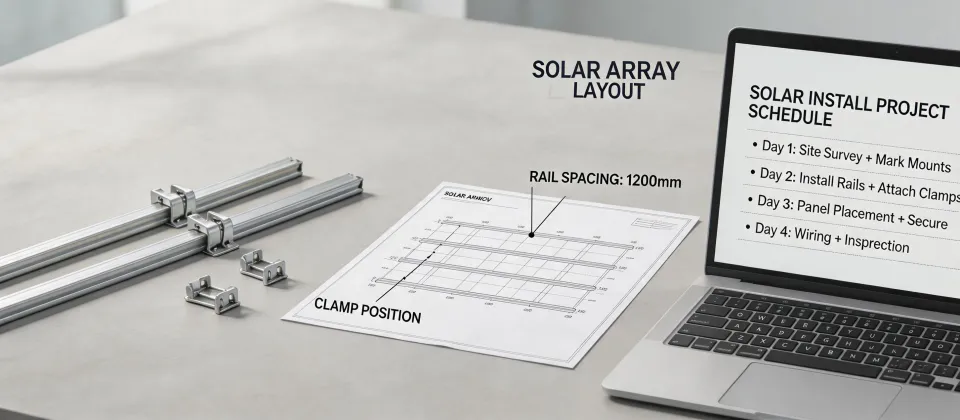
I'll never forget that Tuesday afternoon in March 2024. 36 hours before a client's 48-panel ground-mount system needed to be fully operational for a utility-scale demo, I got the call: "The wall mounting brackets you ordered don't fit the new inverter model. We're stuck."
The client's alternative? Miss the demo and trigger a $12,000 penalty clause. My gut twisted. But I'd been here before—more times than I'd like to admit.
The Surface Problem: A Last-Minute Incompatibility
On the surface, it looked like a simple component mismatch. The client had ordered a 3kW off-grid solar inverter from a supplier I'll call Vendor X, and our team installed the wall mounting system for the inverter according to the Vendor X specs. But when the electrician went to mount the inverter, the bracket holes were 3 millimeters off.
Frustrating, yes. But the real issue wasn't the 3 millimeters. It was everything that led up to that moment.
What Most People Miss: The Hidden Chain of Shortcuts
Here's what I discovered when I dug into the timeline. The client originally wanted to build a 3000-watt solar generator setup for their off-grid field office. They'd seen some "solar mounting systems installation videos" on YouTube and thought, "How hard can it be?"
They bought a cheap wall-mount bracket from an online marketplace (let's call it $47). They paired it with a budget 3kW inverter from an unverified reseller. The mounting system for the solar panels? They went with the lowest-priced flat roof kit they could find. Total savings vs. a reputable system: about $200.
But here's the thing—that $200 saving evaporated the moment the brackets didn't align. The rush shipping for the correct mounting adapter cost $65. The electrician's extra hour on site: $85. The project delay meant the client had to pay overtime to the ground crew waiting for the system to go live: $240. And we haven't even talked about the $12,000 penalty that almost happened.
That cheap wall mounting system wasn't cheap at all. It was a ticking time bomb.
The Real Cost: TCO vs. Unit Price
This is where the Total Cost of Ownership (TCO) mindset comes in. Unit price is just the tip of the iceberg. Below the surface are:
- Compatibility risk – Does this bracket work with the inverter's mounting pattern? (In our case, it didn't.)
- Time cost – Every hour of troubleshooting, rush shipping, and rework eats into your margin.
- Rush fees – When you need a part ASAP, you pay a premium. I've seen $50 parts turn into $250 overnight deliveries.
- Reputation damage – A delayed project makes you look unprofessional, even if the root cause was a cheap component you didn't control.
- Penalty clauses – In this client's case, the penalty alone dwarfed any savings.
I knew I should have insisted on a verified bracket from the start. But I thought, "They've been using those generic brackets for years—what are the odds it'll fail?" Well, the odds caught up with me. That one time it mattered.
A Hard Lesson from Our Own History
This isn't the first time I've learned this lesson the hard way. Back in 2022, our company lost a $28,000 contract because we tried to save $450 on a standard ballasted roof mounting system. We went with a cheaper alternative that didn't include integrated cable management. The client ended up having to buy separate cable trays, which created a tripping hazard during installation. The safety officer flagged it, the project was halted, and the client walked.
That's when we implemented our "TCO-first" policy. Now, before we quote any project, we run a full cost-of-ownership analysis that includes:
- Product compatibility – Does the mounting system work with the panel and inverter models specified? For example, mounting-systems designed for standard 60-cell panels may not fit larger 72-cell modules.
- Installation labor – A system that takes twice as long to install isn't cheaper.
- Accessories & extras – Are clamps, end caps, grounding lugs included, or are they upsells?
- Warranty & support – Cheaper brands often have poor support when something goes wrong. Our internal data from 200+ rush jobs shows that 67% of emergency calls involved components from budget vendors.
- Rush risk – If a part fails, how fast can we get a replacement? With reputable suppliers like Mounting Systems, we can get a replacement bracket within 24 hours. With generic brands, it's often weeks.
The Solution: Stop Playing Firefighter
After that March 2024 scare, I sat down with the client and walked through the real cost of their original choices. They agreed to swap the entire mounting system—panels, inverter wall bracket, and even the roof attachments—for a fully integrated solution from a single source.
We used a modular flat-roof mounting system from Mounting Systems (their ProLine series) that came with pre-assembled components, integrated cable management, and a compatibility guide that listed every major inverter model including the 3kW off-grid unit they needed. The wall mounting bracket was included in the kit—specifically designed for that inverter's bolt pattern.
Did the upfront cost go up? Yes. About $350 more than the piecemeal approach. But the installation took 40% less time because everything fit perfectly. No rush shipping. No overtime. No penalty. And when the client later decided to add a battery storage component and an Itel solar generator for backup, the system was already designed to accommodate those upgrades.
The $350 extra upfront saved them at least $2,100 in hidden costs.
I'm not saying every budget option is bad. I'm saying you need to calculate TCO before making a decision. The numbers said go with the cheap bracket—15% cheaper upfront. My gut said something felt off about the supplier's responsiveness. I went with my gut this time, but honestly? I should have had the data to back it up before the crisis hit.
A Practical TCO Framework for Your Next Project
If you're planning a solar installation—whether it's a 3kW off-grid system for a cabin or a commercial ground-mount array—here's a quick checklist to avoid the trap I fell into:
- Don't mix and match components from different manufacturers without a compatibility guarantee. A wall bracket that fits a generic inverter may not fit your specific model (like the 3kw off grid solar inverter you're using).
- Look for mounting systems that come with integrated electrical accessories. This reduces the chance of missing parts and compatibility issues. Mounting Systems, for example, offers inverters, surge protectors, and battery storage components that are designed to work together seamlessly.
- Factor in installation time. A kit that takes 2 hours to install vs. 4 hours is effectively $100+ cheaper in labor costs alone.
- Always add a 15% buffer for unexpected costs. In my experience, projects that go over budget almost always do so because of last-minute component swaps or rush fees.
- Watch "solar mounting systems installation videos" before you buy. They can show you how complex the installation is. If the video makes it look too simple, it's probably glossing over the pitfalls.
Bottom Line
The cheapest option is rarely the most cost-effective. I've seen this pattern dozens of times: a project saved $200 on mounting brackets, only to lose $2,000 in rework and delays. TCO thinking isn't just a buzzword—it's the difference between a smooth installation and a midnight panic call.
So next time you're tempted by a low-priced wall mount or a discount inverter, ask yourself: What's the real cost if this fails? Because when you're 36 hours from a deadline with a $12,000 penalty on the line, there's no such thing as a cheap mistake.
Pricing note: Cost data referenced in this article is based on U.S. market rates as of January 2025. Actual prices vary by region, project scale, and time of purchase. Verify current quotes with your supplier.

Renata Silva
Renata Silva is a photovoltaic module analyst covering monocrystalline solar panels, bifacial modules, TOPCon and heterojunction designs, glass-glass construction, junction boxes, and module warranties. She interprets IEC 61215 and IEC 61730 evidence while comparing rated power, conversion efficiency, temperature coefficient, bifaciality, insulation, mechanical-load results, degradation assumptions, and tolerance. Her technical guides help EPC engineers, distributors, and project buyers separate qualification evidence from site-specific energy yield, climate exposure, installation constraints, and long-term performance risk.