The Solar Panel Question That’s Missing the Real Decision
2026-06-05 / Renata Silva
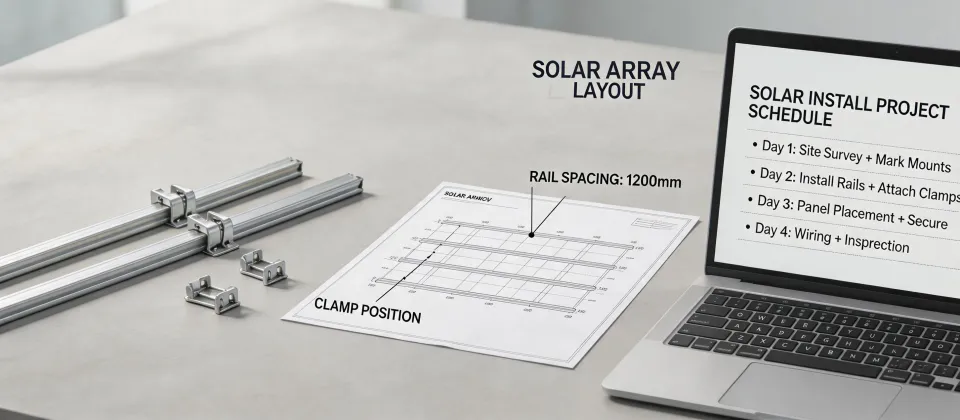
I've been on both sides of this equation. Over four years as a quality inspector reviewing mounting system specs for a renewable energy supplier, I've seen the same mistake play out more times than I can count. A buyer spends three weeks agonizing over panel efficiency ratings, then picks a mounting system in an afternoon. That's backward. But I'm jumping ahead.
The real question isn't just "which solar panel is best." It's about the mounting system that carries, protects, and positions it for 25+ years. For this piece, I'm comparing two broad categories: iron ground mounting systems versus roof-mounted solutions. The comparison framework? Cost, complexity, and long-term reliability. Let's break it down dimension by dimension.
Dimension 1: Upfront Cost & Price Transparency
Price is where most people start, and it's the trickiest comparison. Ground mounting systems—especially solar panel ground mounting systems using steel or iron—typically cost more upfront. You're buying structural steel, concrete foundations, and more labor for trenching and assembly.
Roof-mounted systems are cheaper on paper. Less material, less labor, faster install. But here's the insider thing most people don't realize: roof mounting often comes with hidden costs that don't appear in the first quote.
- Roof penetration waterproofing (not always included)
- Structural reinforcement for older roofs
- Extra labor for roof access and safety equipment
- Potential re-roofing in 10–15 years
In our Q1 2024 quality audit, we reviewed 200+ quote proposals for commercial rooftop installations. Roughly 35% had at least one significant cost line item buried in fine print—usually waterproofing or structural reinforcement. The vendor who lists all fees upfront, even if the total looks higher, almost always costs less in the end. I've learned to ask "what's NOT included" before "what's the price."
So on pure upfront cost, a roof system usually wins. But it's not the full picture. Take this with a grain of salt, because local labor rates vary significantly, but for a typical 50kW commercial installation, I've seen roof systems quote $0.15–0.25/watt, and ground systems $0.25–0.45/watt. The ground system can be 60–80% more expensive initially.
Dimension 2: Long-Term Reliability & Maintenance
This is where the comparison flips. Ground mounting systems, and specifically iron ground mounting systems, are boringly reliable when spec'd correctly. There's no roof to leak, no roof replacement cycle, no weight limit. The structure sits on foundations independent of the building. If a panel fails in year 18, you walk up to it with a lift. Simple.
Roof systems have a harder time in this dimension. That roof is a liability. It will need replacement. The mounting penetrations are a potential leak path. And accessing a rooftop array for maintenance is more dangerous and expensive than ground-level access.
I'll give you a concrete example. In 2022, we specified requirements for a $180,000 rooftop project. The client chose a roof mount to save on initial cost. Within four years, a minor roof leak—unrelated to the install but exacerbated by it—required partial removal of the array to repair. That cost us a $22,000 redo and delayed the launch by nearly a month. The roof system's upfront savings evaporated.
Never expected a ground system to outperform in reliability, but turns out the simpler approach wins for longevity. A properly engineered ground mount essentially becomes a fixed asset with minimal moving parts. The maintenance? Annual bolt torque checks and visual inspection for corrosion. That's it.
Dimension 3: Compliance, Standards & Trust
Now, UL 2703 is the standard for mounting systems in North America. It covers structural, electrical, and fire requirements. In our quality reviews, we reject roughly 8% of first deliveries due to non-compliance with spec tolerances. The most common issue? Post-galvanization coating thickness on iron ground components falling below the 85-micron minimum. Normal tolerance is 10–15% variance. When we see 30% below spec, that batch gets rejected.
Both ground and roof systems can be UL 2703 compliant. But here's something vendors won't tell you: not all compliance is equal. I've seen roof mount systems with "engineering approval" that barely passed structural loading tests. The sticker is on the box, but the safety margin is thin.
Ground systems typically have higher inherent structural safety margins because they're designed for independent wind and snow loads on open terrain. Roof systems are constrained by the roof's load capacity. In practice, that means ground systems can often handle heavier snow loads in northern climates without needing custom engineering.
I have mixed feelings about the "best solar panel" question. Part of me understands why people ask it. Another part knows that the mounting system determines more about long-term performance than the panel brand. A high-efficiency panel on a poorly designed roof mount will underperform a budget panel on a well-engineered ground system.
Which One Should You Choose?
Here’s the practical breakdown, based on the trade-offs I just walked through:
- Choose roof-mounted systems if: You have a sound, low-slope roof in good condition, minimal land, and a tight upfront budget. Accept that you'll need to decommission and recommission when the roof needs replacement. Budget for that.
- Choose iron ground mounting systems if: You have land available, want 25+ year reliability with minimal structural headaches, and can handle the higher initial investment. It's the boring, correct choice for long-term owners.
- For flat roof applications: Consider a ballasted system (if the roof supports the weight) to avoid penetrations. It's a middle ground that trades more weight for less leak risk.
The worst choice? Skipping the mounting system evaluation entirely and just picking whichever looks cheaper. I've seen that mistake cost companies tens of thousands in retrofits and lost production. Don't be that person. Ask the right question first.

Renata Silva
Renata Silva is a photovoltaic module analyst covering monocrystalline solar panels, bifacial modules, TOPCon and heterojunction designs, glass-glass construction, junction boxes, and module warranties. She interprets IEC 61215 and IEC 61730 evidence while comparing rated power, conversion efficiency, temperature coefficient, bifaciality, insulation, mechanical-load results, degradation assumptions, and tolerance. Her technical guides help EPC engineers, distributors, and project buyers separate qualification evidence from site-specific energy yield, climate exposure, installation constraints, and long-term performance risk.