A Buyer's Guide to Solar Mounting Systems: Ground, Roof, Flat Roof, and Carport
2026-06-01 / Renata Silva
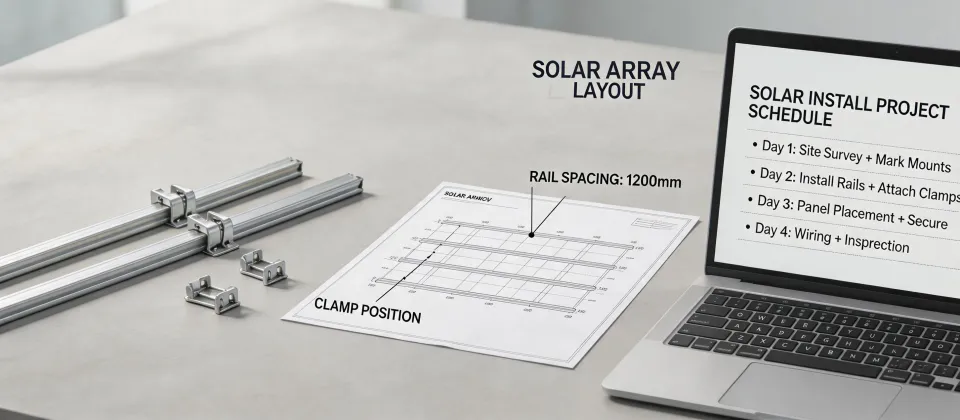
Look, I'm not going to tell you there's one perfect solar mounting system for every project. That would be a lie, and honestly, it would be a disservice to anyone who has to deal with the consequences of a bad match—like me, when I have to explain to Finance why we're paying for a rushed replacement.
If you're in procurement, operations, or project management for a solar installation company, you've likely already heard the debate. Ground mount vs. roof mount. Ballasted vs. penetrated. Aluminum vs. steel. Everyone has an opinion. But the right choice depends on three things: your site, your schedule, and your budget for mistakes (because there will be some).
This guide is based on what I've learned managing orders for mounting hardware across a variety of projects. It's not theory. It's the checklist I wish I had in 2022 when I ordered the wrong flat roof system for a project that absolutely could not be delayed.
1. The Three Real-World Scenarios (Which One Are You?)
From my experience processing around 60-80 orders annually across 8 different vendors, projects fall into one of three buckets. There's no fourth category is just 'easy', because there's always a catch.
- Scenario A: The Greenfield Ground Mount — You have a clear site, no building code surprises, and time to plan. This is the ideal scenario, but it's rarer than you'd think.
- Scenario B: The Retrofit Roof Mount — You're installing on an existing commercial or residential roof. The building is occupied, the roof is a certain age, and the schedule is tight.
- Scenario C: The Flat Roof / Carport Challenge — A flat roof with a low weight tolerance, or a carport that needs to look good and be structurally sound. This is where 'creative' solutions can become expensive problems.
I've handled orders for all three. The mistakes I've made in Scenario C are the ones I remember most vividly (note to self: verify weight limits before ordering ballasts).
2. Scenario A: The Ground Mount (When You Have Space and Time)
This is the textbook scenario. You have land, you've done the soil test, and you have 6-8 weeks to install. Here, a standard ground mounting system is your friend. Think driven piles or ground screws.
What I look for: Cost per watt of the racking, and how quickly it can be assembled. In 2024, we tested a system that claimed a 40% faster install time. It was more expensive per part, but we saved on labor. Quick math: we spent $3,200 more on hardware, but saved $5,500 on labor for a 100kW array. Net win.
One thing they don't tell you: Even with a ground mount, the 'universal' rail claim is a myth. We ordered a 'universal roof rail mounting system' for a carport once (it was a mistake in ordering, my fault). The clamps didn't fit the specific module frame. We had to order adapters, which took 3 extra days (this was back in 2023).
The 'Time Certainty' Premium: If your project has a fixed completion date (like a PPA start date), pay the extra 5-10% for a vendor who guarantees stock and shipping. I remember one project where we saved $1,200 by using a cheaper vendor, but they delivered late. The penalty from the utility was $2,800. Painful, but insightful.
3. Scenario B: The Roof Mount (Speed vs. Trust)
Roof mounts are where the pressure is highest. The building owner wants minimal disruption. The roofer wants to keep the warranty intact. You need a system that is fast, non-penetrating (if possible), and compliant.
Cost-Effective Rooftop Solutions: Most of our roof mount orders now use a flashed, penetrating system for tile roofs, and a ballasted system for flat roofs. The misconception here? That a ballasted system is always 'faster' because you don't drill holes. In reality, the engineering review for a ballasted system (wind calculations, etc.) can take 2 weeks. A simple flashed mount might be installed in 3 days but requires coordination with a roofer.
The communication failure: A year ago, I said 'We need the standard roof kit.' The vendor heard 'the cheapest roof kit.' We ended up with a system that didn't include the grounding lugs (which are required per UL 2703). The electrician flagged it during the inspection. We had to pay a $400 rush fee for the correct parts. That vendor is now on my restricted list.
If your project timeline is under 4 weeks, I recommend paying for a premium kit from a known brand like IronRidge or Schletter (even if I'm not supposed to name them). The documentation and compliance are baked in.
4. Scenario C: The Flat Roof or Carport (The 'It Depends' Zone)
This is the hardest category. Here, the 'one-size-fits-all' approach fails completely.
- Low-Slope Flat Roof (High Weight Tolerance): A standard ballasted mount works. We bought 2,000 lbs of ballast blocks for one 50kW roof. The concrete alone was $1.50 per block. It was simple, but heavy. The structural engineer had to sign off on the roof load.
- Low-Slope Flat Roof (Low Weight Tolerance): This happens more often than vendors admit. You need an adhered or mechanically attached system. This is pricier and slower. We had to switch mid-project in 2024 after the engineer rejected our ballast plan. It cost us 3 weeks and $6,000 in change orders.
- Carport: The carport is about aesthetics and structure. A universal rail system is fine, but I've found that custom-bent steel is actually cheaper for large projects (over 200kW). The setup fee is higher, but the material cost per foot is lower.
The industry myth here is that 'local is always faster.' This was true 5 years ago when logistics were chaotic. Today, a well-organized national vendor with a planned shipping schedule can often beat a local shop that waits for material. We tested this in Q3 2024: a national vendor delivered a full carport kit in 14 days. Our local guy took 22 days.
5. How to Decide Which Scenario You're In
Here's a simple litmus test I use before placing an order:
- Check your deadline: Is it a firm date with penalties? If yes, go with a known, reliable system (pay the time certainty premium).
- Check your roof: Can you afford a 10-psf extra load? If yes, ballasted is fine. If no, you're in Scenario C.
- Check your vendor: Have they sent you a UL 2703 compliance certificate without asking? If they don't have it ready, walk away.
If you can't answer these three questions confidently, you're not ready to order. I learned this the hard way after buying a 'solar panel ground mounting system' that was perfect for one site but completely wrong for another because the soil wasn't tested. The vendor didn't ask. I didn't know. We lost a client.
Final thought (from a buyer who's been burned): The cheapest mounting system is rarely the cheapest project. Factor in labor, compliance, and the cost of a mistake (like a missed deadline). As of January 2025, that lesson is worth more than any hardware discount.

Renata Silva
Renata Silva is a photovoltaic module analyst covering monocrystalline solar panels, bifacial modules, TOPCon and heterojunction designs, glass-glass construction, junction boxes, and module warranties. She interprets IEC 61215 and IEC 61730 evidence while comparing rated power, conversion efficiency, temperature coefficient, bifaciality, insulation, mechanical-load results, degradation assumptions, and tolerance. Her technical guides help EPC engineers, distributors, and project buyers separate qualification evidence from site-specific energy yield, climate exposure, installation constraints, and long-term performance risk.