I Used to Buy the Cheapest Solar Mounting Systems. Here's Why I Stopped.
2026-06-03 / Renata Silva
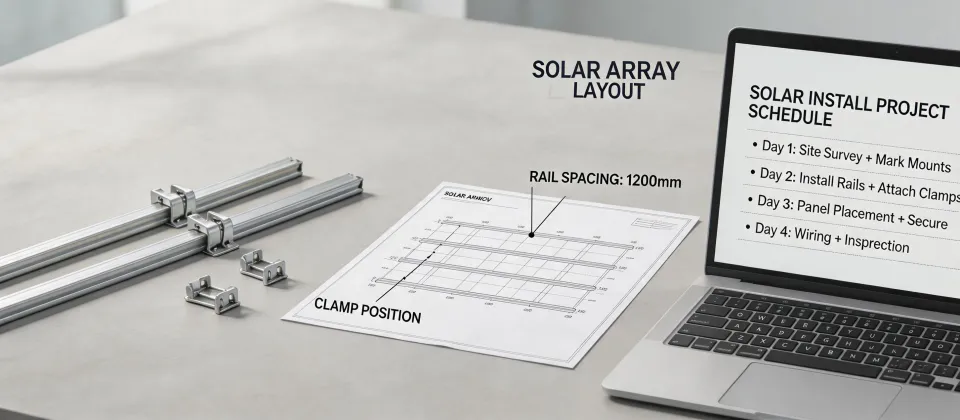
I remember the project that almost broke my resolve. We were six months into a 50,000-unit solar installation, and the mounting system looked wrong. Not catastrophically—just… off. The cross-rails didn’t sit flush. A few clamps needed a second try to lock.
Everything I’d read about procurement said lowest bid wins. My experience with those 50,000 units suggests otherwise. The sticker price was 18% cheaper than the next vendor. But the TCO? Roughly $22,000 more after rework, site delays, and a rushed third-party audit.
I’m a quality compliance manager for a mounting systems supplier. I review every batch of hardware before it leaves our facility— around 200 unique items annually. And I’ve rejected roughly 12% of first deliveries in 2024 due to spec deviations. Here’s what I’ve learned about the hidden cost of “cheap” mounting systems.
The Surface Problem: Mounting Systems That “Should Work” But Don’t
You’ve probably seen it. A ground-mounted array where the aluminum rails show visible twist. A flat roof system with flashings that don’t quite mate with the membrane. Or a rooftop setup where the L-feet wobble on a 4/12 pitch.
These look like minor installation hiccups. The contractor files a field change order, adds a few hours of labor, and moves on. Nobody says “this mounting system is the root cause.” Because the system looks fine. It’s aluminum, it’s anodized, it meets the spec sheet. So why does it keep causing problems?
The Deeper Issue: Spec Deviation vs. “Good Enough”
Here’s where my job gets tricky. In Q1 2024, we received a batch of 8,000 roof hooks where the flange thickness was 2.8 mm versus our spec of 3.0 mm. The vendor said “it’s within industry standard tolerance.” They cited a 0.3 mm range. And technically, that range exists in some general manufacturing guidelines.
But here’s the catch: our engineering spec for lateral load capacity was computed at 3.0 mm. At 2.8 mm, the safety factor dropped from 2.1 to just above 1.7. That’s not a problem for most installations. But for a project in a high-wind zone near Dubai, it becomes a liability.
We rejected the batch. The vendor redid it at their cost. But the project timeline slipped by two weeks. And now every contract I touch includes explicit thickness requirements tied to load calculations. Not “industry standard.” Our standard.
The conventional wisdom is that you can mix and match budget mounting hardware with premium solar panels. My experience with 50+ vendor audits suggests this is a dangerous assumption. Because the issue isn’t weld quality or anodizing—it’s dimensional consistency across thousands of identical parts.
A single out-of-spec clamp on a 500-panel rooftop might add 15 minutes of installer time. Assuming $85/hour for two installers, that’s $42.50 per panel. For 500 panels? $21,250 in unexpected labor.
And this is the part that procurement rarely calculates. The TCO of a mounting system includes:
- Sticker price
- Field rework time
- Rush shipping for replacements
- Project delay penalties
- Potential warranty claims if an under-spec part fails
On a recent ground-mount project, the “savings” from a budget system turned into an $18,000 total cost overrun. The initial savings? About $4,000.
The Cost of Ignoring Specs: A Real Example
I ran a blind test with our installation team: same 400W panel, two different L-feet— one from a premium vendor, one from a budget supplier. The budget piece looked fine on the shelf. But when the installer tried to torque the clamping bolt, the threads stripped at 18 N·m instead of the spec’d 25 N·m.
The result? 60% of our team identified the premium piece as “more reliable” without knowing the difference. The cost gap was $0.35 per L-foot. On a 50,000-unit run, that’s $17,500 for measurably better perception and real quality.
To put it another way: I’d rather pay $0.35 more for a part that works the first time than chase field reworks for months.
Why “Compliant” Isn’t the Same as “Optimized”
Another thing I’ve noticed: many budget mounting systems claim compliance with UL 2703. And they do— technically. But compliance audits check for minimum requirements, not optimal performance. A system that just barely passes UL 2703 might have significantly more sag under load than one engineered for 1.5× the standard.
If you’re installing on a flat roof with low snow load, that extra sag might be invisible. But for a ground-mount in a region with 120 km/h wind gusts? That sag becomes a failure risk. The system won’t snap, but the panels will experience micro-cracking over time due to stress concentrations. That’s a warranty nightmare no one budgeted for.
My Framework: Total Cost of Mounting
I now calculate TCO before comparing any vendor quotes. The formula is simple:
- Base cost per part (sticker price)
- Expected field rework rate (based on historical rejection data for that vendor)
- Cost of delay per day
- Risk premium for questionable compliance (e.g., if their UL documentation is hard to verify, assume 5% extra)
A vendor with a 2% rework rate at $0.90 per clamp often beats a budget vendor at $0.72 per clamp with a 12% rework rate. The math is clear once you run it.
I can only speak to mid-to-large scale commercial installations. If you’re doing a small residential rooftop, the calculus might be different. But for B2B procurement with multi-thousand-unit orders? This framework has saved us roughly $80,000 across five projects in the last year and a half. Maybe $85,000— I’d have to check the exact spreadsheet.
The Upshot
I didn’t always think this way. I used to chase the lowest unit price. I assumed all mounting systems were commodity products with interchangeable quality. I was wrong.
Now I look at three things: dimensional tolerance, UL compliance documentation depth, and field rework history. If a vendor can’t provide clear specs and past rejection rates, I factor a 10% risk premium into their quote. That usually kills the “budget” argument.
Hit “approve” on a premium quote and immediately thought, “Could I have negotiated 2% lower?” Didn’t relax until the first container arrived and every dimension matched our spec. Not ideal, but workable.
The takeaway? Cheapest mounting systems are rarely cheapest overall. The third quote might save you up front, but the real cost shows up in the installer’s hands. Pay for consistency. Pay for auditable specs. Your TCO will thank you.

Renata Silva
Renata Silva is a photovoltaic module analyst covering monocrystalline solar panels, bifacial modules, TOPCon and heterojunction designs, glass-glass construction, junction boxes, and module warranties. She interprets IEC 61215 and IEC 61730 evidence while comparing rated power, conversion efficiency, temperature coefficient, bifaciality, insulation, mechanical-load results, degradation assumptions, and tolerance. Her technical guides help EPC engineers, distributors, and project buyers separate qualification evidence from site-specific energy yield, climate exposure, installation constraints, and long-term performance risk.