I Almost Chose the Wrong Solar Mounting System: A Procurement Manager’s Cost Breakdown
2026-07-10 / Renata Silva
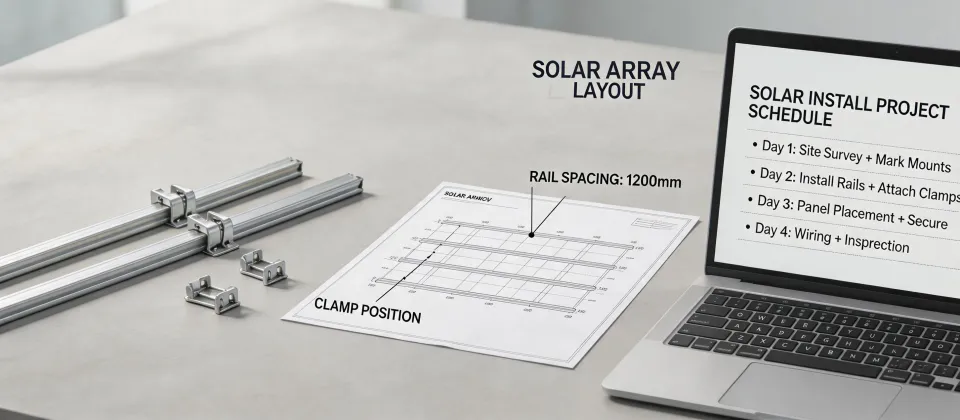
It was a Tuesday afternoon in late February 2024 when the project landed on my desk. A 500kW rooftop installation for a local manufacturing plant. My boss, the Operations Director, had given me the green light to source the mounting system and electrical accessories. The budget was set, but the pressure was on to find the best value. I thought I knew the drill. I was wrong.
I'm the procurement manager at a mid-sized solar installation company. I've been managing our component budget—roughly $180,000 annually—for about six years now. I've negotiated with maybe 20 different vendors across mounting hardware, inverters, and BOS components. I keep a detailed cost tracking spreadsheet that borders on obsessive. You'd think I'd be immune to a simple pricing trap. I wasn't.
We were evaluating types of solar panel mounting systems for this flat roof project. The requirement was clear: a penetrated system with a 20-degree tilt to maximize yield. We had quotes from three vendors. Vendor A offered a complete flat roof solution. Vendor B, a racking system Dubai specialist, came in with a lower upfront price tag. I almost signed with Vendor B. Here's why I didn't, and why that decision saved us nearly 15% of our annual budget.
The Temptation of the Low Price
Vendor B's rep was persuasive. The base unit price for their aluminum rails and clamps was about 12% lower than Vendor A's. The pitch was simple: "Same specs, lower price. What's not to like?" I'd heard that line before, but the numbers were compelling. For a 500kW system, that 12% difference translated to a significant chunk of change. I was ready to pull the trigger.
But then I remembered a hard lesson from 2023. I'd assumed 'same specifications' meant identical results across vendors for a smaller ground mount project. Didn't verify. Turned out each had slightly different interpretations of 'wind load rating.' We had to re-engineer the ballast plan, costing us $1,200 in extra labor and a week of delay. I learned never to assume the proof represents the final product after that incident.
The Hidden Cost Breakdown
I decided to run a full total cost of ownership (TCO) analysis. I compared costs across all three vendors, not just the unit price. This is where the story gets interesting. I built a spreadsheet with the following line items:
- Unit price of rails, clamps, and splices
- Shipping costs (to Dubai, in this case)
- Customs clearance fees
- Lead time and the cost of delay
- Warranty terms and replacement part availability
- Technical support responsiveness (a gut-check from past experience)
Vendor B's base price was lower, but they charged a separate 'logistics fee' of $2,500 for the shipment. Their standard lead time was 28 days, compared to Vendor A's 18 days. We calculated the cost of that 10-day delay on the project timeline—our installation crew would be idle, costing roughly $800 per day in overhead. That's an $8,000 hidden cost right there.
"I don't have hard data on industry-wide hidden fee percentages, but based on my six years of tracking every invoice, my sense is that at least 15% of 'budget savings' on low upfront quotes get eaten by unlisted charges."
On top of that, Vendor B's warranty required us to ship defective parts back to their regional warehouse at our cost. Vendor A had a local distributor who could swap out parts within 48 hours. When I accounted for the potential of a 2% defect rate (based on past experience), the replacement cost for Vendor B was significantly higher. (Note to self: always verify the local stock agreement before committing.)
The Turning Point
The moment of truth came when I compared the final TCO. Vendor A's quote: $38,000 all-in. Vendor B's initial quote: $34,200. But after adding the logistics fee, the delay cost, and the potential warranty handling, Vendor B's TCO ballooned to $42,600. That's a 12% difference in Vendor A's favor, hidden in the fine print.
I have mixed feelings about the whole experience. On one hand, I feel stupid for almost falling for a classic upfront price trap. On the other, I'm glad I had the systems in place to catch it. This worked for us, but our situation was a large, time-sensitive commercial project. If you're dealing with a small residential retrofit where lead time and defect rates are less critical, the calculus might be different. I can only speak to our context as a mid-size installer with tight project schedules.
The Result & The Lesson
We went with Vendor A. The project came in on time and under budget. Their technical support team was responsive when we needed to clarify a few details on the roof plan. More importantly, we avoided the 'free setup' trap that would have cost us dearly in delays. (I really should document this TCO process as a formal policy for the company.)
The biggest lesson? No single vendor has 'the best' mounting system. There's only the most suitable one for your specific project constraints. If Vendor B had offered faster shipping and a local stock agreement, they might have won the bid. I recommend Vendor A for commercial flat roof projects with tight deadlines, but if you're dealing with a flexible timeline and have your own stock of universal parts, Vendor B's base price could be attractive.
As of early 2025, the market for solar mounting systems in the region is still competitive. But my advice is simple: don't let the upfront price blind you. Run the TCO. Check the fine print. And if a deal seems too good to be true, it probably hides costs that will show up later.
I don't have a perfect system for predicting every hidden cost. But after tracking 180,000 dollars in cumulative spending over 6 years, I can tell you one thing with confidence: the cheapest quote is rarely the cheapest project.

Renata Silva
Renata Silva is a photovoltaic module analyst covering monocrystalline solar panels, bifacial modules, TOPCon and heterojunction designs, glass-glass construction, junction boxes, and module warranties. She interprets IEC 61215 and IEC 61730 evidence while comparing rated power, conversion efficiency, temperature coefficient, bifaciality, insulation, mechanical-load results, degradation assumptions, and tolerance. Her technical guides help EPC engineers, distributors, and project buyers separate qualification evidence from site-specific energy yield, climate exposure, installation constraints, and long-term performance risk.