Solar Mounting Systems: 8 Questions Procurement Teams Actually Ask (And What the Answers Cost)
2026-05-18 / Renata Silva
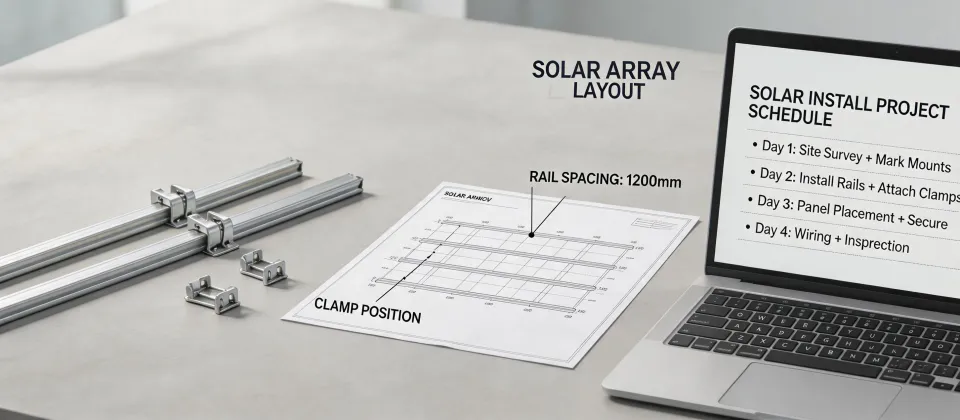
If you're sourcing mounting systems for a solar project, you've probably realized the price on the quote sheet is just the beginning. Over the past six years of tracking every invoice across $180,000+ in solar hardware spending, I've learned that the real cost of a mounting system isn't what you pay upfront—it's what you pay over the life of the installation.
This FAQ covers the questions I wish someone had answered for me before I committed to our first bulk order.
1. What's the difference between ground, roof, and flat roof mounting systems?
People think the main difference is just the roof pitch. Actually, the structural requirements and labor costs vary more than the hardware itself.
Ground mounts typically use driven posts or concrete foundations. Roof mounts require flashings and waterproofing. Flat roof mounts often use ballasted systems (concrete blocks) to avoid penetrating the membrane.
If I remember correctly, our ground mount project cost about 25% more in foundation labor than the hardware itself. The roof mount? That was the opposite—hardware was the bigger line item.
2. Are cheaper sensor mounting systems worth it for a 500kW installation?
Here's the thing: that $0.02-per-watt savings on sensors sounds great until you factor in calibration drift. We compared quotes from three vendors for a 500kW flat roof system in Q2 2024. Vendor A quoted $4,200 for their sensor package. Vendor B quoted $3,100.
I almost went with B until I calculated TCO. B charged $650 for annual recalibration. A included it. Over a 10-year lifespan, A's total was actually $400 less. That's a 10% difference hidden in fine print.
My advice: Ask about calibration costs upfront. Sensor accuracy failures can lead to underperforming arrays—and that's a much bigger expense than the sensors themselves.
3. Do space saver tv mounting systems have any application in solar?
I know this sounds like a weird cross-over. But the principle of compact, adjustable mounting is relevant to solar carport designs. Some carport mounting systems use similar space-saving rail designs to maximize panel density in tight layouts.
Honestly, I'm not sure why more manufacturers haven't adapted space-saver concepts for solar carports. My best guess is the structural load requirements for PV panels are different enough that it's not a direct fit. But the idea of maximizing usable surface area? That's universal.
If you're designing a carport system, ask your vendor about rail spacing optimization. The difference between standard spacing and optimized spacing can be 5-8% more capacity in the same footprint.
4. How do I compare quotes for snap solar system mounting hardware?
Snap-together systems sound great in theory. But here's what I learned the hard way: the 'snap' doesn't always click.
We ordered 200 units of a snap-fit system from a budget vendor. Saved $1,200 upfront. Then 40% of the clips failed the torque test during installation. The reorder—with expedited shipping—cost us $1,800. Net loss: $600, plus two weeks of schedule delay.
Look, I'm not saying snap systems are bad. But test 10 units before you order 200. The time to find a quality issue is before the shipment arrives, not after.
5. What's the real cost of an ev charger installation with mounting?
This is a tangent, but it matters for commercial solar projects. If you're adding EV charging to a solar install, the mounting for the charger unit itself is a small cost—usually $100-200 for a wall mount or pedestal.
The bigger cost is the electrical work: conduit, breaker upgrades, and load calculations. I've seen quotes range from $800 to $2,500 for a single Level 2 charger installation. The mounting hardware is the easy part.
Quick tip: Some mounting system vendors bundle charger mounts with their solar racking. Ask if they offer a package discount.
6. How much does a wind turbine blade cost—and what does it have to do with solar?
A single wind turbine blade for a utility-scale turbine (2-3 MW) costs roughly $200,000 to $400,000. That's for a 40-60 meter blade. It's a completely different cost structure from solar.
But here's the connection: if you're comparing solar versus wind for a commercial installation, the mounting infrastructure is a major cost differentiator. Solar mounting systems are modular and relatively simple. Wind turbine foundations and towers require heavy civil engineering.
In my experience, solar wins on total cost for installations under 10 acres. Wind only becomes competitive for larger footprints with consistent wind profiles.
7. Should I use ballasted or penetrated mounting for a flat roof?
The assumption is that ballasted is cheaper because you avoid roof penetrations. The reality is that ballasted systems require more structural engineering to verify roof load capacity. That engineering can cost $2,000-$5,000 for a single building.
Penetrated systems, while requiring flashing and waterproofing, are often lighter and don't stress the roof structure as much. For a roof with limited load capacity, penetrated may be the only option.
From experience: Get a structural engineer involved before you choose. The 'cheaper' option on paper may be the more expensive option when you factor in engineering costs and potential roof damage.
8. How do I evaluate a mounting system vendor's UL 2703 compliance?
UL 2703 is the standard for mounting systems in North America. But compliance isn't binary—there are different levels of certification.
I want to say every vendor I've worked with claims UL 2703 compliance. But when I actually asked for the certification documents, only three out of five could produce them. The other two had 'self-certified' or were 'in the process.'
My rule now: Request the UL certification letter before issuing a PO. If they can't provide it within 48 hours, they're probably not compliant. And non-compliance can void your project's insurance and warranty.
Prices and specifications as of January 2025; verify current rates with vendors.

Renata Silva
Renata Silva is a photovoltaic module analyst covering monocrystalline solar panels, bifacial modules, TOPCon and heterojunction designs, glass-glass construction, junction boxes, and module warranties. She interprets IEC 61215 and IEC 61730 evidence while comparing rated power, conversion efficiency, temperature coefficient, bifaciality, insulation, mechanical-load results, degradation assumptions, and tolerance. Her technical guides help EPC engineers, distributors, and project buyers separate qualification evidence from site-specific energy yield, climate exposure, installation constraints, and long-term performance risk.