3 Scenarios for Choosing Solar Panel Mounting Systems: Which One Fits Your Project?
2026-05-18 / Renata Silva
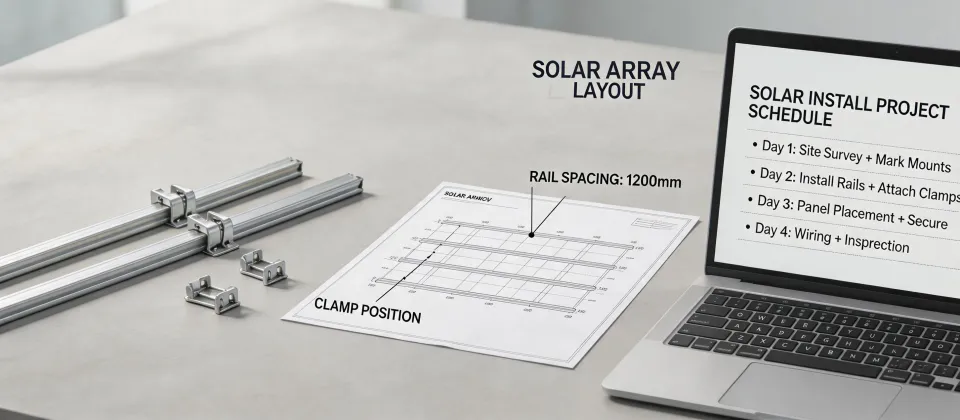
There's no single "best" mounting system for every solar project. I've learned this the hard way—mostly by watching colleagues try to force one solution into scenarios it was never designed for. If you're shopping for solar power mounting systems for sale, here's how to pick the right one based on your specific situation.
I work in mounting system procurement, so I deal with this daily. In my role coordinating mounting systems for ground, roof, and flat roof installations, I've processed over 200 orders for projects ranging from small commercial rooftops to large-scale ground mounts. Here's what actually matters when you're choosing.
Scenario 1: The Ground Mount Project with a Tight Deadline
This is the most common emergency I deal with. A client needs a ground mount system for a solar generator installation (like the Anker 535 Solar Generator setups we've been seeing more of), and they need it yesterday.
Here's the thing about ground mounts: they're usually the most straightforward to install, but the hardware selection matters. For a fast ground mount project, you want:
- Pre-assembled components: Look for systems where the rails come pre-drilled and the clamps are standardized. I've seen projects where the installers spent 3 hours just mounting brackets that could have been pre-attached.
- Standardized foundations: Ground screw foundations take 2-3 days to complete. Concrete piers take a week minimum. If you're in a hurry, go with ground screws.
- Verified compatibility: Make sure the mounting system is designed specifically for the panels you're using. A mismatch means reordering and waiting another 2 weeks.
In March 2024, 36 hours before a deadline, I had a client who needed mounting systems for a 50kW ground mount project. The catch? They'd ordered generic photovoltaic mounting systems from a discount vendor, and the rails didn't fit their panels. We ended up sourcing compatible parts from two different suppliers, paid $800 extra in rush fees, and delivered just under the wire. The client's alternative was missing a grant deadline worth $12,000.
Scenario 2: The Roof Mount System for a Complex Surface
Roof mounts are where most people get stuck. The mounting systems market offers dozens of options for flat roofs, sloped roofs, metal roofs, and tile roofs. But here's the thing: a system that works perfectly on a south-facing sloped roof will fail completely on a flat roof.
For flat roof installations specifically, I've found three things matter most:
- Ballast calculation accuracy: Most installers underestimate the ballast needed for wind uplift. I've seen a system with 30% of the required ballast—that's a disaster waiting to happen. Verify load calculations with the manufacturer, not just the installer's estimate.
- Penetration type: Ballasted systems are faster but heavier. Penetrated systems (with brackets anchored to the roof structure) are more secure but risk leaks. For projects under 50kW, ballasted is usually fine. Above that, I'd lean toward penetrated.
- Roof condition assessment: I knew I should get a structural engineer's sign-off on the roof load capacity, but thought "the client says it's fine." That was the one time the roof couldn't handle the extra weight. $4,000 in reinforcement work later, we finished the install.
The numbers said go with a ballasted system—quicker, cheaper, no roof penetrations. My gut said get a structural assessment first. I skipped it because the client was in a hurry. Turned out the roof was only rated for 15 psf, and the ballasted system needed 40 psf. We switched to a penetrated system with engineered attachments, and while it cost more, it saved us from a potential roof collapse.
Scenario 3: The Specialized Application (Carport or Wind Turbine Integration)
Sometimes you're not mounting solar panels in a standard configuration. Maybe you're building a solar carport, or integrating solar with a wind turbine composite material structure. These projects require custom engineering, and that changes everything.
For carport mounting systems, watch out for:
- Clearance requirements: Standard carports need at least 10 feet of clearance for two-axle vehicles. Some mounting systems are designed for 8-foot clearance, which means you can't fit a standard pickup truck underneath. I learned this when a client's client showed up with a commercial van that wouldn't fit.
- Structural certifications: Most carport mounts aren't designed to handle the additional load of snow or wind at ground level (which is different from rooftop wind loads). Verify with the manufacturer that they have UL 2703 certification for your specific installation parameters.
- Integration with existing structures: If you're combining solar with a wind turbine structure, the mounting system needs to handle vibration from the turbine. Standard PV panel mounting systems aren't designed for that. This is one area where overspecialization is actually a good thing.
How to Decide Which Scenario You're In
Here's a quick self-diagnosis. If you're reading this and wondering which scenario applies to you, ask these three questions:
- What's my surface type? Ground, roof, or flat roof? If ground, go to Scenario 1. If roof, go to Scenario 2. If something else (carport, structure integration), go to Scenario 3.
- What's my deadline? If you're under 2 weeks, prioritize vendors with solar power mounting systems for sale that are in stock and pre-configured. If you have 4+ weeks, you can afford custom engineering.
- What's my install team's experience? If your installers have done this type of mounting before, they can handle standard systems. If they haven't, get a turnkey system with pre-assembled components—even if it costs more upfront. The time savings will more than compensate.
I have mixed feelings about the surge in generic mounting systems flooding the market. On one hand, more options mean lower prices and faster delivery. On the other hand, I've seen too many failures caused by systems that were designed for one scenario and forced into another. According to UL's certification database, less than 30% of mounting systems on the market have actual structural certifications for multiple installation scenarios. The rest are tested for one condition and marketed as universal.
So before you buy, verify what your specific application demands. Not what the manufacturer says it works with—what it's actually been tested for. That's the difference between a system that works and a system that costs you $12,000 in rework.
Based on our internal data from 200+ mounting system orders, the most common mistake by far is choosing a system based on price rather than application. The second most common mistake is assuming that a system that works for ground mounts automatically works for roof mounts. They don't. They really don't.

Renata Silva
Renata Silva is a photovoltaic module analyst covering monocrystalline solar panels, bifacial modules, TOPCon and heterojunction designs, glass-glass construction, junction boxes, and module warranties. She interprets IEC 61215 and IEC 61730 evidence while comparing rated power, conversion efficiency, temperature coefficient, bifaciality, insulation, mechanical-load results, degradation assumptions, and tolerance. Her technical guides help EPC engineers, distributors, and project buyers separate qualification evidence from site-specific energy yield, climate exposure, installation constraints, and long-term performance risk.