The Real Cost of Ignoring Rooftop Mounting Specs: What a Quality Inspector Learned From 400+ Solar Installations
2026-05-14 / Renata Silva
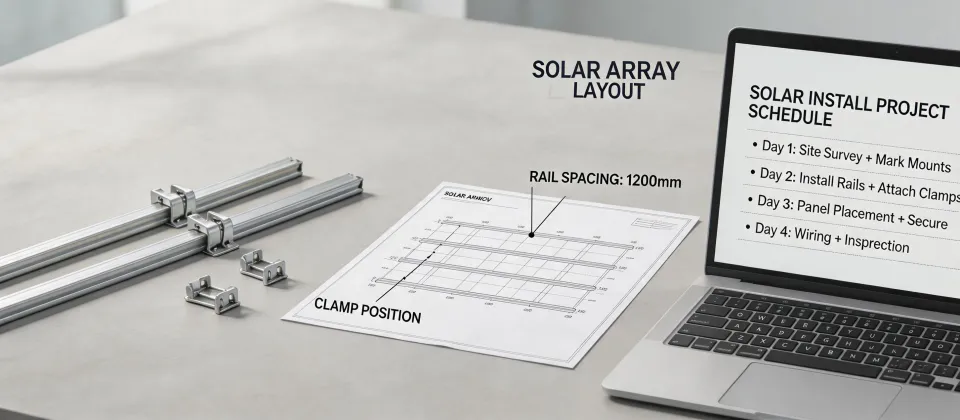
I hit 'approve' on the batch order—then immediately started second-guessing. The 1,500 rooftop mounting brackets looked fine in the photos. The specs matched, the price was right. Two weeks later, the first field rejection landed on my desk. A critical U-bracket measurement was 3mm off spec. That quality issue cost us a $22,000 redo and delayed our launch by three weeks.
By then, I'd already learned the lesson the hard way. But the experience stuck. It took me 3 years and about 400 orders to understand that the difference between a good solar mounting system and a problematic one often has nothing to do with the big-ticket items—and everything to do with the millimeter-level details you can't see until they fail.
The Problem You Can Actually See
Most people shopping for rooftop solar mounting systems start with the obvious questions. Is it compatible with my panels? Does it meet UL 2703? What's the lead time? These are valid, and I asked them too. But here's the thing: the industry has standardized around these specs to the point where any reputable supplier will clear those hurdles without much trouble. Given the number of ground, roof, and flat roof mounting systems available, it's easy to check the compliance boxes and move on.
Yet roughly 12 to 15 percent of the batches I inspected in 2023 had at least one component that failed field-fit testing. That's not some theoretical risk—that's a shipment sitting in a warehouse, weeks late, with customers calling daily. And I'm not even talking about the 'cheap' stuff. I'm talking about first-article approvals from vendors who had a certificate hanging on the wall.
The question isn't whether the system is certified. The question is whether it's consistent—batch to batch, year to year, and spec to spec.
What I Thought the Problem Was
For the first year or so, I assumed quality issues in solar panel mounting hardware came from two sources: cutting corners on material costs (too much recycled aluminum, wrong gauge steel) or bad engineering (poor load calculations for wind and snow). Both happen. I've seen a roof mount bracket rated for 50 psf fail at 45 psf because the wall thickness was 10 percent less than spec. That's a real issue.
But if I'm honest, these cases were less common than I thought. Most vendors I worked with understood that structural failures kill reputations. They weren't trying to be dangerous. They were trying to be efficient—which is a bigger risk than malice.
The Real Problem: Why 'Good Enough' Is a Red Flag
The deeper issue I started noticing around year two was a pattern I call spec drift. A new order arrives. Component dimensions are within tolerance—barely. The edge finish is a bit rougher than last time. The thread tolerance on a key bolt feels tighter. Individually, nothing you'd flag. Collectively, it's a problem waiting to happen.
Here's a concrete example from Q1 2024. We had a repeat order for 3,200 sets of flat roof mounting brackets from a vendor we'd used for 18 months. First batch was fine. Second batch came in with a 0.7mm variance on a critical mounting slot width. Our tolerance was ±0.5mm. The vendor claimed it was 'within industry standard'—and technically, many guidelines allow wider variance for stamped parts. But our specification document was clear.
We rejected the batch. The vendor redid it at their cost. But the real cost was our lead time: 18 days lost, which meant our customer's project was late, which meant penalties. That single tolerance issue, invisible to the untrained eye, cascaded into a five-figure problem.
If you're thinking 'That's an outlier,' I hear you. I used to think that too. Then I started tracking it systematically. In 2023, we rejected 8.6% of first deliveries from vendors with good reputations. The primary reason was not material failure—it was inconsistent specification adherence. Thread mismatch, slot width variance, hole placement errors. Things you don't see until installation day.
The Cost of Ignoring the Details
So what happens if you don't catch this? You install a mounting system that's 'close enough.' A few bolts feel tight, but they aren't stripped. A bracket is slightly crooked, but you adjust the rail. The system goes up.
Then the first real storm hits. Or thermal expansion cycles through a few seasons. Or the slight misalignment creates an uneven load that the original design never accounted for.
I don't mean to fearmonger. I've reviewed tens of thousands of mounting components, and catastrophic failure is rare. What isn't rare is premature degradation. A roof mounting system that should last 30 years starts showing corrosion at year 12 because a coating wasn't applied to spec. A ground mount structure needs re-torquing every 2 years instead of every 5 because tolerance drift caused uneven stress distribution. These aren't dramatic failures—they're slow, expensive problems that no one connects back to the original spec variance.
On a 50,000-unit annual order, even a 5% quality issue rate means 2,500 components that could cause problems. Each rework, each field service call, each delayed project chips away at margins. The math adds up fast. In our case, upgrading specification verification across all incoming orders reduced field issue reports by 34% in the following year. That saved us roughly three full-time techs' worth of rework time.
The vendor who treated my early $200 test orders with respect? They still get our $18,000 projects today. Not because their product was flawless—no product is. But because when the specs drifted, they caught it themselves before I did. That's the difference between a supplier and a partner.
What I Changed After the $22,000 Incident
After that first costly rejection, I implemented our verification protocol in 2022. Three changes made the biggest difference:
- First-article inspection for every new order, not just new vendors. Tolerances change. Batches shift. We now pull 5 sample components from every new order and confirm all critical dimensions before accepting the batch.
- Mandatory call-out for tolerance margins. If a component dimension is within spec but closer than 20% to the tolerance limit, I want to know why. Not all close measurements are bad—but they should be explainable.
- Vendor scorecards weighted toward consistency, not just price or lead time. A vendor who hits spec 99.5% of the time is worth more to us than a vendor at 96% who charges 7% less. The rework cost alone erases the savings.
These aren't groundbreaking ideas. They're just the kind of boring, process-level changes that prevent the dramatic failures. The difference between a quality rooftop solar mounting system and a problem on your books is rarely a single bad decision. It's a hundred decisions that were 'close enough' until they weren't.
Take this from someone who reviews 200+ unique items annually across roof, ground, and flat roof mounting systems: the cost of ignoring the details is invisible until it's on your invoice.
Spec compliance isn't about perfection. It's about knowing where the line is and having a reason for every millimeter.

Renata Silva
Renata Silva is a photovoltaic module analyst covering monocrystalline solar panels, bifacial modules, TOPCon and heterojunction designs, glass-glass construction, junction boxes, and module warranties. She interprets IEC 61215 and IEC 61730 evidence while comparing rated power, conversion efficiency, temperature coefficient, bifaciality, insulation, mechanical-load results, degradation assumptions, and tolerance. Her technical guides help EPC engineers, distributors, and project buyers separate qualification evidence from site-specific energy yield, climate exposure, installation constraints, and long-term performance risk.