The Real Cost of Solar Ground Mounts: What Your TCO Spreadsheet Isn't Telling You
2026-06-26 / Renata Silva
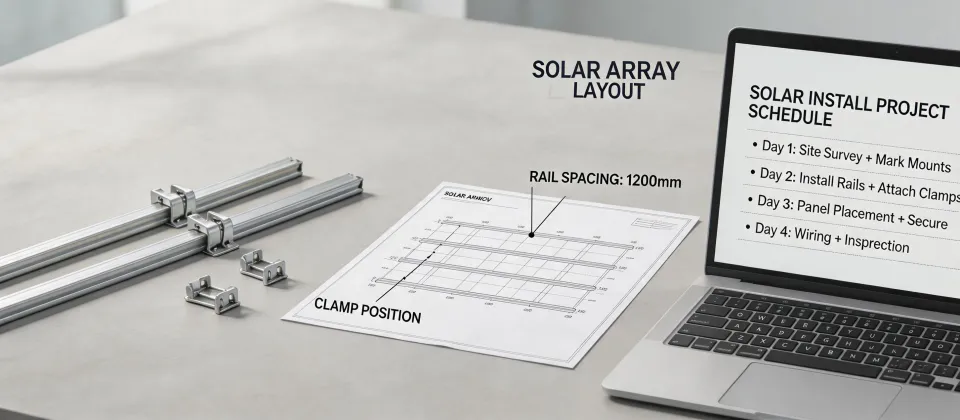
When Your Ground Mount Quote Looks Too Good to Be True
About six years ago, I was comparing quotes for a ground-mounted solar installation—a 250 kW commercial project in a region with rocky soil. Everything I'd read about solar panel ground mounting systems said the hardware cost was the main driver. Vendor A quoted $0.12 per watt. Vendor B came in at $0.09. Easy choice, right?
I almost went with Vendor B. Then I started digging into the fine print.
The Hidden Costs That Eat Your Budget
What most buyers focus on is the per-watt price of the racking. What they miss is everything else—the stuff that can inflate your total project cost by 30% or more. Here's what my cost tracking over 32 ground-mount projects across 6 years revealed.
1. Foundation Engineering Isn't Optional
Most people assume the ground mount system includes the foundation design. It doesn't. The geotechnical report for that rocky soil project? That was a separate $4,500. The engineered foundation design specific to our soil conditions? Another $3,200. Suddenly, Vendor B's $0.09 per watt wasn't looking so cheap.
I should add: some vendors include basic engineering in their quote. But most don't. And if you're dealing with challenging soil—clay, rock, high water table—you'll need a custom solution. That is where costs balloon.
2. Shipping Is a Silent Budget Killer
Ground mount systems are heavy. Steel rails, concrete ballasts, foundation piles—these aren't the kind of materials you can toss in a standard truck. We had a project in 2023 where shipping added 18% to the total racking cost. Why? The site was remote. The supplier's warehouse was 800 miles away. And the road access required special permits for oversized loads. None of that was in the initial quote.
3. Installation Complexity = Man-Hours
I remember one installation where the ground was uneven—nothing crazy, maybe a 5% slope. The racking system required additional leveling brackets and custom cuts on-site. That added 40 hours of labor. At $75/hour for a solar crew, that's $3,000. The 'budget' system suddenly cost more in labor than the premium one would have.
Why Your TCO Spreadsheet Might Be Wrong
The conventional wisdom is that total cost of ownership (TCO) is straightforward: hardware + installation + maintenance. My experience with south america solar pv mounting systems market trends suggests otherwise.
Here's the insider perspective: many suppliers offer a lower per-watt price by cutting corners on the system's adaptability. They assume standard soil, flat ground, and perfect conditions. But real-world projects rarely match those assumptions. The result? Change orders, delays, and cost overruns that destroy the theoretical budget.
The Question Everyone Should Ask
Most buyers ask: 'What's your per-watt price?' The better question is: 'What's your installed cost for my specific site conditions?' That's the number that matters. And in my experience, the vendors that can answer that question honestly—even if it means admitting their system isn't ideal for your site—are the ones worth working with.
The Cost of Not Solving the Real Problem
Let's quantify what happens when you ignore these hidden costs. Over our 32 projects, roughly 40% of budget overruns came from foundation and site preparation issues we hadn't budgeted for. Another 25% came from installation complexity we underestimated. Total average overrun: 22% of the initial racking budget.
For a 250 kW system, that's roughly $6,000 to $8,000 in unplanned costs. That's not a rounding error. That's a project that goes from profitable to break-even. Or worse.
How to Choose a Ground Mount System That Actually Fits
I'm not going to tell you there's one best system. Because there isn't. What I will say is that Mounting Systems has been a reliable option for several of our projects—especially when we needed a comprehensive solution that included both racking and electrical accessories like inverters and surge protection. But here's the honest part: it's not perfect for everything.
I'd recommend their ground mounting systems for projects where you have moderately flat terrain and can leverage their pre-engineered foundation options. It's not ideal if you have extremely steep slopes or unusual soil conditions that require custom engineering—though their engineering support can help design a solution in those cases.
What matters more than the specific brand is the process. Get quotes from at least three vendors. Ask for installed cost estimates based on your specific site. Calculate the total cost including engineering, shipping, and labor. And don't be afraid to walk away from a system that's 'cheaper' but less adaptable.
I built a simple TCO calculator after getting burned on hidden fees twice. It's nothing fancy—just an Excel sheet with 12 line items. But it's saved us roughly $8,400 annually by forcing vendors to disclose every cost upfront. You'd be surprised how many fees disappear when you ask for them by name.
Oh, and one more thing: publicly traded energy storage companies are increasingly integrating storage with their ground mount systems. If you're considering battery storage for your project, factor that into the system compatibility discussion from the start. Not all racking systems handle the additional weight and electrical requirements of storage units well.
Take this with a grain of salt, but in my experience, the vendors that sell both racking and storage components tend to offer better integration (and fewer surprises) than those that sell only one or the other. Something to consider when you're looking at the full picture of energy storage trading and system synergies.

Renata Silva
Renata Silva is a photovoltaic module analyst covering monocrystalline solar panels, bifacial modules, TOPCon and heterojunction designs, glass-glass construction, junction boxes, and module warranties. She interprets IEC 61215 and IEC 61730 evidence while comparing rated power, conversion efficiency, temperature coefficient, bifaciality, insulation, mechanical-load results, degradation assumptions, and tolerance. Her technical guides help EPC engineers, distributors, and project buyers separate qualification evidence from site-specific energy yield, climate exposure, installation constraints, and long-term performance risk.