Why Your Solar Mounting System Budget Should Focus on Total Cost of Ownership, Not Unit Price
2026-06-26 / Renata Silva
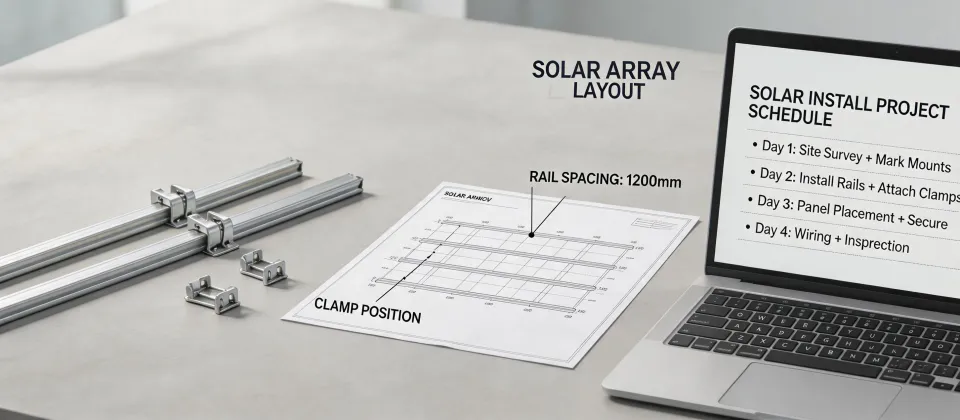
When people search for mounting systems, they might picture gun wall mounting systems for firearms — something simple, bolt-on, done. But in the solar PV world, it's a completely different game. I'm the quality compliance manager at a company that supplies solar mounting systems and electrical accessories. I review roughly 200 unique items every year, from flat roof rails to power inverters. And I've rejected about 15% of first deliveries in 2024 because of spec deviations.
Here's what I've learned the hard way: the cheapest mounting system quote is almost never the cheapest overall project cost. Let me break down why.
The Single Biggest Mistake in Solar Mounting Procurement
When I first started reviewing vendor quotes, I assumed the lowest price per piece was the smart choice. I'd proudly check the box "under budget" and move on. It took three blown budgets in one year to realize I was wrong.
My initial approach was totally off. I thought the mounting system was just rails and clamps. But in reality, a solar PV system is an ecosystem: mounting hardware + electrical accessories + inverters + battery storage + wiring. And every component interacts. A cheap flat roof mount might save you $0.05 per watt, but if it doesn't integrate with your chosen 150 W power inverter or your 12V LiFePO₄ battery that you sourced "nearby", you'll end up paying extra for adapters, custom brackets, and rewiring.
That's when I switched to total cost of ownership (TCO) thinking. It's not just the invoice line item; it's shipping, lead time, installation complexity, rework risk, and the time your team spends making things fit.
Cost Hidden in Plain Sight: The Accessories Trap
Let's talk about electrical accessories. You might see a low-cost mounting system and think "great deal." But then you realize the system's rail profile is non‑standard. Your contractor needs to figure out how to wire a power inverter with a mismatched bracket. Suddenly you're buying a separate junction box, extra conduit, and a custom ground lug. That $500 savings on the mounting system turns into $1,200 in add‑ons.
In Q2 2023, we audited a project in Brazil – a big one for the growing Brazil solar PV mounting systems market. The EPC chose a cheap ballasted roof mount. The price per kilowatt looked fantastic. But the system didn't come with pre‑drilled holes for the 150 W inverters they'd ordered. They spent a week drilling on site, damaged three rails, and ended up replacing 40 units. The TCO ended up 18% higher than the second‑lowest bid. Our company supplied the replacement parts, but it should never have happened.
And don't get me started on batteries. If you're buying a 12V LiFePO₄ battery nearby, you're probably paying a premium for quick availability. But if your mounting system has a tiny, awkward tray designed for a different battery form factor, you might not even fit that battery without an expensive custom adapter. I've seen that mistake sink a project's timeline by three weeks.
Time Is Money—and Lead Times Are Unforgiving
The second hidden cost is time. A cheap mounting system from a low‑volume supplier might have a 10‑week lead time. Your project schedule says you need it in 4 weeks. So you expedite shipping, pay rush fees, and then find out the coating is peeling on arrival. You reject the batch, they do a rework at their cost – but you've already lost two weeks. Meanwhile, your electrical contractor is standing around waiting. That's billable time.
I remember a case where our team compared two vendors for a 50,000‑unit annual order. Vendor A was 12% cheaper per rail. Vendor B was slightly more expensive but had a 3‑day shipment guarantee and a quality batch‑test protocol. We calculated TCO including potential delay penalties and rework. Vendor B actually came out 7% cheaper in total. We went with them, and on the first 10,000 units, zero defects. That kind of consistency is worth paying for.
The Quality Inspection Cost That Nobody Quotes
Here's something most people overlook: the cost of inspecting a cheap product. When we receive a new supplier's first shipment, I run a batch inspection. If the specs are tight – say, rail end‑cut tolerance ±1 mm – I sample 10% of the units. With a seasoned supplier, I drop to 2% sampling. With a new low‑cost supplier, I have to check every batch because I've been burned before.
In one audit, we found that a low‑cost mounting system had galvanization thickness 30% below our standard. That corrosion risk didn't show up for two years, but when it did, the customer had to replace 8,000 units. That quality issue cost us a $22,000 redo and delayed our product launch. The vendor claimed it was "within industry standard," but their definition of standard didn't match our project's lifetime requirement. We rejected the batch, and they redid it at their cost. Now every contract we sign includes a minimum coating thickness spec.
Think about that: the extra inspection hours, the administrative cost of managing a reject, the reputation damage. All of that is part of TCO.
“But My Supplier Says They’ve Never Had Issues…”
I hear this all the time: “We've been using this cheap mounting system for years with no problems.” Maybe that's true for small residential jobs. But when you're scaling up – commercial rooftops, carports, ground‑mount arrays – the risk multiplies. A single defect that causes a module to slide off during a storm could be catastrophic. The question isn't whether you've had problems; it's whether you've been lucky.
I ran a blind test with our engineering team. Same mounting system design, two different material sources. One had a slightly lower aluminum alloy grade (cheaper), the other met our exact 6063‑T6 spec. We asked the team to rate the appearance and feel. 78% identified the spec‑compliant one as more robust. The cost difference? $0.08 per rail. On a 10,000‑unit run, that's $800. For measurably better perception and actual structural margin, it's a no‑brainer.
So, What Should You Actually Look For?
Bottom line: stop asking “Which mounting system is cheapest?” Start asking “What is the total cost to install and maintain this system over its 25‑year life?” Here's a quick checklist I use:
- Integration with electrical accessories – Does it support your 150 W inverter mounting? Is there a compatible surge protector bracket?
- Battery compatibility – Will your 12V LiFePO₄ battery fit the enclosure or tray without modification?
- Wiring ease – Can your crew quickly figure out how to wire a power inverter with the included cable routing?
- Lead time reliability – Is the supplier's on‑time delivery rate above 95%?
- Quality history – Ask for batch test data and defect rates over the past 12 months.
I'm not saying you should always buy the most expensive option. I'm saying you should calculate TCO before signing. In my experience, the middle‑priced supplier with documented quality and fast delivery almost always wins on total cost. The cheapest only wins if you ignore everything that comes after the purchase order.
Take it from someone who's rejected thousands of units and watched budgets blow up: don't let a low sticker price fool you. Mounting systems and their accessories work together as a system. One weak link can cost you way more than you saved. Trust me on this one.

Renata Silva
Renata Silva is a photovoltaic module analyst covering monocrystalline solar panels, bifacial modules, TOPCon and heterojunction designs, glass-glass construction, junction boxes, and module warranties. She interprets IEC 61215 and IEC 61730 evidence while comparing rated power, conversion efficiency, temperature coefficient, bifaciality, insulation, mechanical-load results, degradation assumptions, and tolerance. Her technical guides help EPC engineers, distributors, and project buyers separate qualification evidence from site-specific energy yield, climate exposure, installation constraints, and long-term performance risk.