The 36-Hour Rush: When a Rooftop Mounting System Almost Failed (and What I Learned)
2026-05-19 / Renata Silva
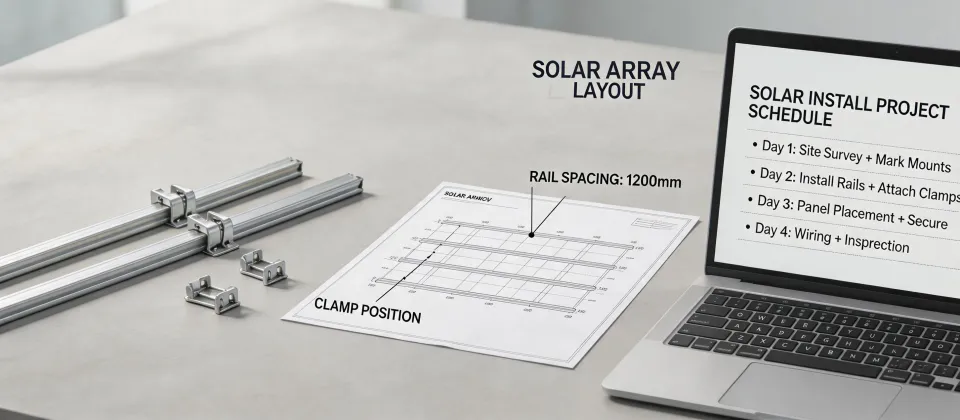
It was a Tuesday afternoon in March 2024, 36 hours before the deadline. The client—a commercial solar installer I’d worked with for years—called me in a panic. They had just realized their roof mounting system for a 50kW flat roof installation didn’t fit. The ballasted mounts they ordered had the wrong base plate spacing. Their alternative was to fabricate custom parts onsite, which would have blown the timeline and voided their UL 2703 certification. I’m a project manager at a mid-sized mounting systems distributor, handling rush orders for utility and commercial clients. In my role triaging emergency supply requests, I’ve learned one thing: when a deadline is that tight, you can’t afford to be a generalist. You need a specialist who knows their limits.
The Setup: Why the Standard Solution Wasn’t Gonna Work
When I first started managing rush orders for solar mounting hardware, I assumed that the fastest fix was always the cheapest one—or at least the most obvious one. I thought, “We’ve got a catalog full of compatible parts, just pick something close enough.” That assumption cost me dearly twice. The first time, a ground mount order arrived with incompatible clamps because I picked a “universal” option that turned out to be anything but. The second time, we shipped a roof mounting system that was structurally fine but didn't meet the local wind load codes. Both ended in re-orders, re-shipments, and angry calls.
This client’s problem was specific: they needed a flat roof mounting system for a high-traffic commercial building, with a 10-degree tilt, ballasted with concrete blocks, and fully compliant with UL 2703 for bonding and grounding. The original vendor they used had a 14-day lead time. My company had a similar product in stock, but it was a different brand. The question was: could I mix and match parts from different mounting system types and still maintain the certification? Most buyers focus on price and speed, and they completely miss compliance compatibility. The question everyone asks is, “Can you get it here in time?” The question they should ask is, “Will it still be certified when it arrives?”
The Middle: 24 Hours of Triage, Two Key Decisions
I called my head of technical sales at 2:30 PM. We spent 45 minutes going over the product datasheets. The client’s specified rails were from one manufacturer, the clamps from another, and the ballast brackets from a third. My gut said this was a mix-and-match nightmare. But my head said, “If I say no, they lose the contract.” I didn't fully understand the value of manufacturer-specific certification until a $3,000 order came back completely wrong. We’d once lost a $47,000 contract in 2022 because we tried to save $400 on a pre-assembled racking kit instead of ordering the certified system. The consequence was a failed inspection, a two-week delay, and a liquidated damages clause that cost us $8,000. That’s when we implemented our manufacturer-matched certification policy. Now, we only sell mounting systems where all components from the same brand and UL listing.
The first major decision: I told the client, “We can’t offer a multi-brand solution and guarantee UL 2703. But we can offer an alternative from our stock that’s a single-brand, certified flat roof system. It costs $1,200 more than your budget, and it arrives tomorrow by 10 AM with a rush shipping fee of $600.” The client paused. I could hear them checking with their site supervisor. The site supervisor was worried about the cost overrun. But the alternative was worse: a non-certified system that could void their insurance and trigger a $50,000 penalty clause from the building owner for missing the grand opening date.
The second decision came when my logistics coordinator flagged a potential issue: the driver for the rush shipment was scheduled for a different route. We paid $450 extra to redirect the truck, which cut our profit on the order to almost zero. But that was a no-brainer for me. The client had a project at stake. In my role coordinating emergency deliveries for time-sensitive installations, I’ve learned that a super responsive support team is worth way more than a cheap part. Our company policy now requires a 48-hour buffer on all engineered-to-order items, precisely because of what happened that Tuesday. We learned that being the specialist who says “I can’t do that, but here’s who can” builds more trust than being the generalist who tries everything and fails.
The Result: Delivered, Certified, and a Changed Perspective
The mounting system arrived at the job site at 9:47 AM the next morning. The installation team had it bolted down by 2 PM. The inspection passed the same afternoon. No penalty clause. No voided warranty. The client called me back to thank me and admitted, “I thought you were just upselling me. But you saved our ass.”
That moment changed how I approach sales. People think expensive certified components are a mark-up game. Actually, the cost of a single failure—a lawsuit, a re-install, a lost client—makes certified hardware look cheap. The causation runs the other way. I’d rather work with a specialist who knows their limits than a generalist who overpromises.
Looking back, the real lesson wasn’t about logistics or shipping fees. It was about knowing your boundaries. The vendor who says, “this isn’t our strength—here’s who does it better,” earns my trust for everything else. Now, every single time I sit down to quote a flat roof, carport, or ground mount system, I ask myself: “Am I the specialist, or am I pretending to be one?” And if I’m not, I’m learning to say no. It’s saved me more money and more sleep than any rush fee ever cost me.
Editor's Note: This is a personal account from a project manager in the solar mounting industry. The specific customer is anonymized, but the events and decisions are real. For comparison, standard online mounting system distributors like 48 Hour Print work well for repeat orders with 3–7 day lead times—but for emergency compliance-critical builds like this, specialist certified hardware is the only way to go.

Renata Silva
Renata Silva is a photovoltaic module analyst covering monocrystalline solar panels, bifacial modules, TOPCon and heterojunction designs, glass-glass construction, junction boxes, and module warranties. She interprets IEC 61215 and IEC 61730 evidence while comparing rated power, conversion efficiency, temperature coefficient, bifaciality, insulation, mechanical-load results, degradation assumptions, and tolerance. Her technical guides help EPC engineers, distributors, and project buyers separate qualification evidence from site-specific energy yield, climate exposure, installation constraints, and long-term performance risk.