7 Solar Mounting System Questions I Wish Someone Had Answered Before My First Install (And a UK PV Installer's Honest Take on Energy Storage)
2026-05-22 / Renata Silva
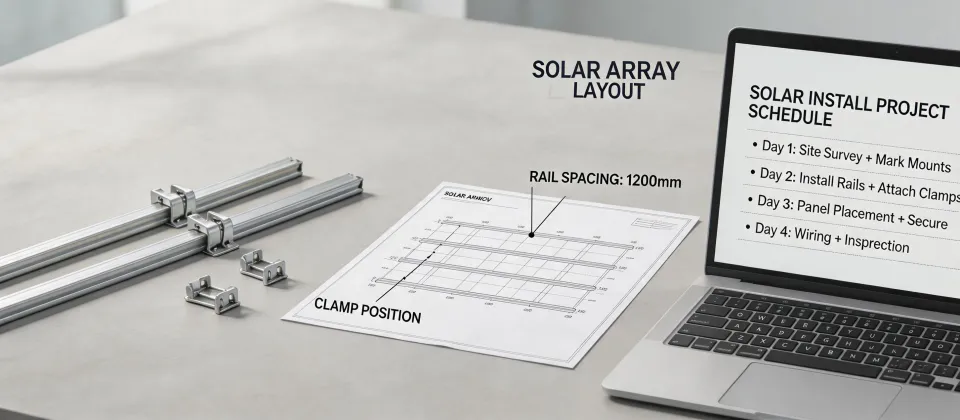
Alright, let's cut the fluff. I've been handling solar PV mounting system orders for about four years now, and I've personally made enough mistakes that my boss started calling me 'the canary in the coal mine' for our supply chain. I've wasted roughly $8,600 on wrong hardware, rushed deliveries, and parts that just didn't fit. So, I wrote a checklist for my team. This FAQ is basically that checklist, but for you.
Here are the questions about mounting systems I wish someone had answered for me back in 2021.
1. What exactly makes a mounting system 'compliant' with UL 2703, and do I need it for a UK project?
Great question, and a common point of confusion. UL 2703 is a North American standard covering the fire rating and mechanical loading of solar mounting systems. If you're working on a project in the UK, the primary standard you'll bump into is the MCS (Microgeneration Certification Scheme), specifically MCS 012 for mounting structures.
But here's the kicker: Just because a system says 'MCS certified' doesn't mean it's built for UK winds or a specific slate roof.
What I am seeing more of is that premium mounting system suppliers (like those using aluminum alloys 6005-T5) are dual-certifying. It's a good sign of quality. For my UK clients, I always say: Check for MCS 012 compliance first. UL 2703 is a nice-to-have, not a must-have, unless you're shipping to the US.
My Mistake: In Q3 2022, I told a client their ground mount system was 'fully compliant' without specifying which standard. They assumed it was for a UK council project that required specific MCS documentation. It wasn't. The order was rejected, costing us a week of delay and a very uncomfortable phone call.
2. Ground mount vs. roof mount: which one is actually more cost-effective for a UK residential project?
It depends on your roof. This is one of those decisions where the textbook answer ('roof is always cheaper') is a trap.
Roof mount saves on structure cost because you're using the existing roof. But:
- If the roof is complex (multiple angles, slate, old tiles), labor goes through the roof (pun intended).
- You're limited by roof orientation. South-facing is ideal, but if you've got a great field behind the house, ground mount is a no-brainer.
- Grid connection costs can be higher for roof installations depending on the house's existing electrical setup.
Ground mount is often better for larger arrays (10kW+) or if the roof is a pain. The structure itself is more expensive, but installation can be simpler.
Based on quotes we got from UK suppliers in 2024:
- Cost-effective roof mount (standard gable): ~£1.20-1.50/watt (including mounting).
- Ground mount (standard field): ~£1.60-2.00/watt (including structure).
My takeaway: Don't just assume roof is cheaper. Actually model the labor and find a roof mount system that works with your roof type. I've seen 50kW commercial roof installations where the ground mount was actually cheaper because the roof was a nightmare.
3. I've heard 'suppressor mounting systems' are a thing. What are they, and should I care?
You might be thinking of surge protective devices (SPDs) or lightning arrestors. A 'suppressor mounting system' isn't a standard term in PV. It's likely a mix-up between 'suppressor' (a component) and 'mounting system' (the structure).
What you probably need:
- Type 2 SPDs: Essential for any string inverter system to protect against transient overvoltages (like lightning). Mounts on the AC side of the inverter.
- Type 1 SPDs: For systems with external lightning protection.
The mounting for these is usually a simple DIN rail clip, not a separate 'mounting system'. But the question tells me you're thinking about safety, which is good.
4. Flat roof mounting systems: is it true that you 'don't need to penetrate' the roof?
Yes, but with a massive caveat.
Ballasted flat roof systems (using concrete blocks) are a thing. They are great for flat roofs where you want to avoid penetrations (potential leaks). The system relies on the weight of the ballast to hold the panels down.
However, ballast works because of friction and weight. For a typical UK flat roof (like on a commercial building or a new build), you usually need about 30-50kg of ballast per panel. That's a lot of weight. If your roof's load capacity is only 50kg/m² (standard for some retrofits), you can't ballast the whole array without reinforcing the building structure.
My recommendation: For flat roofs, ballasted is the standard if load capacity allows. But always, always get a structural engineering calc. I once had a client who refused the engineer's calc because it was 'too expensive.' We ballasted a 50kW array. The roof felt like it was moving. We de-installed and used a penetrate-and-seal system with a flashings instead. That cost us £4,000 and a lot of crow.
5. How does an energy monitoring system help, and what's a reasonable price for one in Healdsburg, CA (or anywhere)?
An energy monitoring system is what turns a dumb solar array into a smart asset. It tracks production in real-time, shows you consumption, and alerts you to issues (like a panel shading issue or a string failure).
For a UK or US home:
- Basic module: Monitors total production from the inverter. Cost: £200-400 / $250-500.
- Per-circuit monitoring: Tracks individual appliances (like heat pump, EV charger, oven). Cost: £400-800 / $500-1,000.
- Professional integration (like Fronius Data Manager or SolarEdge gateway): Included with most premium inverters.
In Healdsburg? I don't have specific local data, but a standard residential monitoring setup with a web portal (like what you get with a SolarEdge or Enphase system) is usually included in the inverter package. If you're looking for external monitoring (like a Sense monitor), budget $300-500.
Personal experience: In 2023, I had a client whose system was producing 30% less than expected for 6 months. He didn't have monitoring. The issue was a shading from a new growth tree. He lost 30% of his generation. A simple monitoring system would have flagged it in week 1. That tree cost him about £900 in lost FIT payments.
6. Hydrogen energy storage for residential: is it a real thing yet, or just hype?
This is the question everyone's asking. The answer is: it's real, but not practical for most homes yet.
Hydrogen energy storage involves using excess solar energy to split water (electrolysis) into hydrogen, which you store. Then, you run that hydrogen through a fuel cell to generate electricity when the sun isn't shining.
The reality check:
- Efficiency: The round-trip efficiency (electricity → hydrogen → electricity) is around 35-45%. Compared to a lithium battery (90%+), that's terrible.
- Cost: A home hydrogen system (like the LAVO system or similar) costs $15,000-$25,000 installed for about 40kWh of storage. A comparable lithium battery (Tesla Powerwall, 13.5kWh) costs $10,000. You need 3x the hardware for the same output.
- Space: Hydrogen tanks take up a lot of room.
Where it makes sense: For off-grid applications where you need huge storage (weeks of autonomy) or seasonal storage. For a standard grid-tied home in the UK or California with net metering? The battery is the clear winner until hydrogen technology improves.
7. What about portable power stations? Are they any good for backup?
Sure, for small stuff. A portable power station (like a Jackery, Bluetti, or Goal Zero) is essentially a LiFePO4 battery with an inverter and a few outlets. They're great for camping, running a CPAP machine during a blackout, or powering a laptop for a day.
But here's the trap: Don't confuse a portable power station for a whole-house backup solution.
A standard 1,000Wh unit (about $1,000) can run a fridge for maybe 10-15 hours. That's it. A 5,000Wh unit ($3,000-4,000) can run a fridge, some lights, and a laptop for a day.
Vs. a solar generator (battery + solar panels):
- Portable power station: Best for temporary backup or mobile use. No solar panels needed.
- Solar generator: A permanent installation. Best for whole-house backup and self-consumption.
My simple rule: If you need backup for a weekend camping trip, get a portable station. If you're trying to power your house for a week, get a solar battery system. Don't mix them up.
Prices are as of January 2025 (based on verified online quotes and industry averages, including MCS and RECC guidelines). Always verify current pricing with your supplier.

Renata Silva
Renata Silva is a photovoltaic module analyst covering monocrystalline solar panels, bifacial modules, TOPCon and heterojunction designs, glass-glass construction, junction boxes, and module warranties. She interprets IEC 61215 and IEC 61730 evidence while comparing rated power, conversion efficiency, temperature coefficient, bifaciality, insulation, mechanical-load results, degradation assumptions, and tolerance. Her technical guides help EPC engineers, distributors, and project buyers separate qualification evidence from site-specific energy yield, climate exposure, installation constraints, and long-term performance risk.