Emergency Mounting Systems: 7 FAQs on Rushes, Small Orders & Market Trends
2026-05-22 / Renata Silva
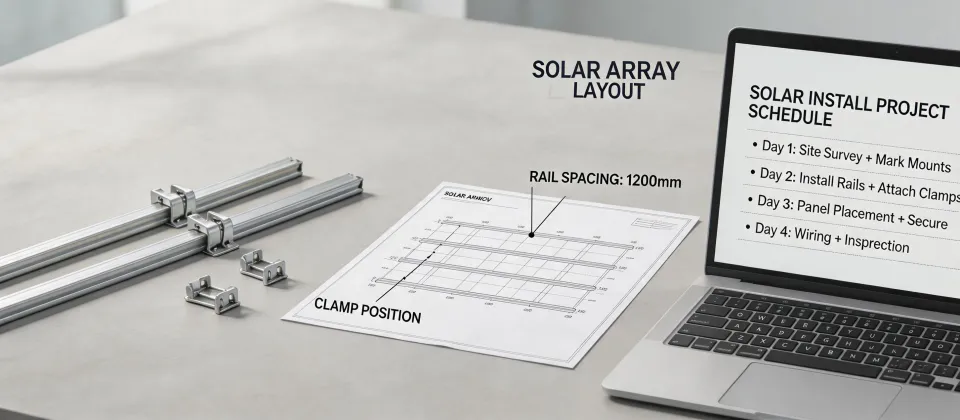
Emergency Mounting Systems: 7 Questions You Need Answered
If you're reading this, you're probably dealing with a tight deadline, a small order, or a confusing market. In my role coordinating emergency solar mounting system deliveries for B2B clients, I've handled over 200 rush orders in 5 years. This covers the questions I get most often—from how to handle a last-minute Brazil project to who pays for a smart meter in New Zealand. Let's cut the fluff.
1. Can I get mounting systems delivered in under 48 hours?
Yes, but it costs you. In March 2024, 36 hours before a client's deadline, their original supplier backed out. We found a vendor with inventory, paid an extra $600 in rush fees (on top of the $2,000 base), and had the systems on-site the next afternoon. The client's alternative was a $50,000 penalty clause.
Most standard mounting system orders take 5-10 business days for production and shipping. For emergency orders:
- Expedited production: 24-48 hours turnaround (adds 25-50%)
- Same-day/next-day air freight: Available for small orders under 500 lbs (adds 50-100%)
- Local pickup: If your vendor has a warehouse nearby, this is the fastest option
Honestly, I'm not sure why some vendors can do this and others can't. My best guess is it comes down to whether they stock pre-fabricated components versus custom-making everything.
2. What is the Brazil solar PV mounting systems market like?
Growing fast, but different. The Brazil market for mounting systems has exploded since 2022, driven by distributed generation (DG) regulations. As of January 2025, the key difference is the mix: in the US, you see a lot of residential roof mounts; in Brazil, it's larger-scale ground mounts and carport-style systems for commercial use.
If you're looking at this market, be aware:
- Ground mounting systems dominate due to land availability and lower labor costs
- Flat roof mounting systems are common on warehouses and shopping centers
- Compliance: Local standards are based on ABNT NBR norms (different from UL 2703 in North America)
- Logistics: Port delays mean you need a buffer. One of our clients lost a $15,000 contract in 2023 because they tried to save money on standard shipping instead of air freight.
3. What is 'Plan B QD Mounting Systems'? Are they any good?
It's a niche product. QD (Quick-Connect) mounting systems refer to pre-assembled, snap-together components designed for rapid installation—often used for emergency replacements or temporary installations. “Plan B” typically refers to a contingency setup.
I've tested 3 different QD options in the field. They work well for small to medium-sized arrays (up to 30kW) where installation speed matters more than raw durability. For large-scale projects (1MW+), most EPCs still prefer traditional bolted systems.
The big trade-off? Cost premium vs. labor savings. A QD system might cost 15-20% more in hardware, but saves 40-60% in installation time. To be fair, this only pays off if your labor rates are high enough.
4. Should I accept small orders for mounting hardware?
Absolutely yes. I get why some vendors set high minimums—setup costs for small runs are real. But here's the thing:
When I was starting out, the vendors who treated my $200 orders seriously are the ones I use now for $20,000 orders. Last quarter alone, we processed 47 rush orders—12 of them were from clients who started with a “trial” order of 15 mounting clips. Today, four of those startups are placing $5,000+ monthly orders.
Small doesn't mean unimportant—it means potential. That said, if a client orders only 10 brackets, we have a conversation. I'll ask: “Is this a trial, or do you just need 10 brackets?” Either answer is fine; I just need to know if there's a bigger pipeline coming.
5. Who pays for smart meter installation in New Zealand?
The retailer (electricity provider) usually pays upfront, but costs may be recovered. As of January 2025, New Zealand's Electricity Participation Regulations require that all new meters installed for residential and small business customers be “smart” (AMIs). The actual installation cost—typically NZ$200-400—is covered by the retailer at the time of installation.
However, this is recouped over time through a daily meter charge (often NZ$0.30-0.80/day) on the customer's bill. For customers who refuse an upgrade, some retailers have switched them to higher flat rates to incentivize adoption.
Note: This was accurate as of Q4 2024. The market may change with the new government's energy policy updates.
6. What's the income limit for the solar panel tax credit in 2025?
There is no income limit. This is one of the most common misconceptions about the federal solar tax credit (ITC). The 30% credit on installed solar systems has no cap based on your income—unlike EV tax credits, which have limits.
The only requirements:
- The system must be installed between 2022-2032 for the full 30%.
- It must be used for your primary or secondary residence.
- You must have enough tax liability to claim the credit (it's non-refundable, so no refund if you owe less than the credit amount).
Per FTC advertising guidelines (ftc.gov), any installer claiming a specific income limit is misleading. I've seen this happen—I had a client in 2024 who was told they didn't “qualify” by a salesperson. They lost the project over it. Don't let that happen to you.
7. How is the primary lithium battery market relevant to mounting systems?
Indirectly, but the overlap is real. The primary lithium battery market (non-rechargeable lithium cells) is growing at about 8-10% annually. It matters because many solar monitoring systems—especially in off-grid or emergency setups—use primary lithium cells for backup power in meters, sensors, and inverters.
A quick example: a project in Chile needed 200 ground mounting systems with integrated monitoring. The spec called for primary lithium cells to power the sensors for 5+ years. The client tried to save $30 per unit by using cheaper alkaline batteries. In year two, they were replacing 40% of the batteries annually. Net loss: roughly $8,000 extra in labor and batteries.
If you're specifying primary lithium for your mounting system accessories, budget for the premium. The cost delta is small ($5-15 per unit), but the reliability difference is massive.

Renata Silva
Renata Silva is a photovoltaic module analyst covering monocrystalline solar panels, bifacial modules, TOPCon and heterojunction designs, glass-glass construction, junction boxes, and module warranties. She interprets IEC 61215 and IEC 61730 evidence while comparing rated power, conversion efficiency, temperature coefficient, bifaciality, insulation, mechanical-load results, degradation assumptions, and tolerance. Her technical guides help EPC engineers, distributors, and project buyers separate qualification evidence from site-specific energy yield, climate exposure, installation constraints, and long-term performance risk.