The Actual Solar Mounting System Checklist Every Admin Buyer Needs (2025)
2026-05-25 / Renata Silva
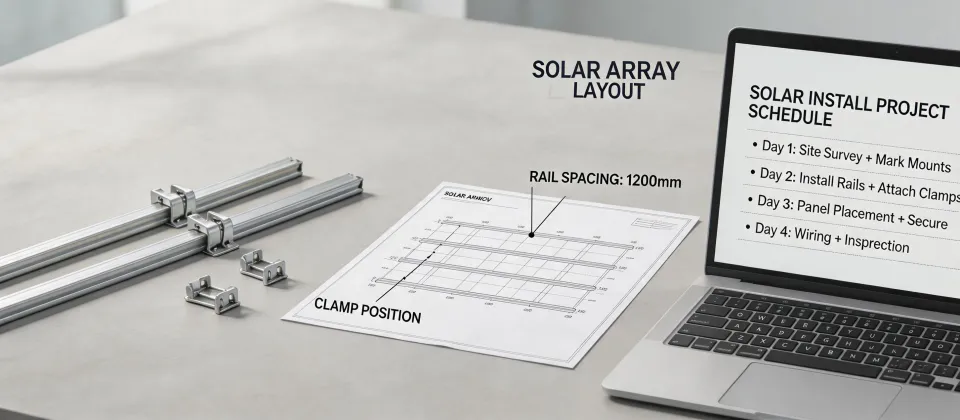
If you're the person in your company whose job description includes "and other duties as assigned" and that somehow landed you buying solar mounting systems… I feel you.
When I took over purchasing for our renewable energy projects in 2020, I knew nothing about photovoltaic mounting systems. Zilch. I was handed a spec sheet and a panicked look from the operations manager. That first order for ground mounting systems almost went sideways. I learned the hard way that a checklist beats panic every time. Here is the 5-step checklist I now use for every solar mounting hardware purchase—it'll save you from eating a $2,400 mistake like I did.
Who This Checklist Is For (And When To Use It)
This is for you if: You're ordering solar panel mounting systems for the first time (or the fifth time, but it's still confusing), you're trying to figure out what type you need—roof mounting, flat roof mounting, or carport solar mounting systems—or you're comparing vendors and wondering if those low prices are actually a bargain.
Use it when you have a project on the desk and a quote in your inbox. It takes about 20 minutes to run through. I've used it on orders for ground mounting systems (the most common for our projects) and for carport solar mounting systems (the one that requires the most coordination).
Step 1: Lock Down The Mounting Type & Site Conditions
This sounds obvious. It's the step everyone skips. Don't skip it. I saw spec sheets that said "ground mount" and I thought, great, done. But there are different types for different ground conditions—soil type, frost line, wind zone. A one-size-fits-all approach doesn't exist for photovoltaic mounting systems.
Here's your check: The site survey should answer three questions. 1) What is the roof or ground material? Asphalt shingle, metal seam, concrete flat roof, or bare ground. 2) What is the local wind and snow load requirement? This is not optional. It's a structural thing. 3) Is there existing infrastructure? Like conduit runs, electrical panels, or trees causing shade. If the vendor doesn't ask you these, that's a red flag.
We had a situation where the operations team said "it's a flat roof." I assumed ballasted. Turns out the roof couldn't support the extra weight of a ballasted system. We had to pivot to a penetrated system (which meant roof work, permits, and a very grumpy finance manager). Had I checked the roof load spec first, we'd have saved a week. (note to self: never assume).
Step 2: Verify Compatibility (Not All Panels Fit All Mounts)
Here's where I made my first $400 mistake. I ordered mounting systems based on the panel dimensions I had on the product page. The panel manufacturer had updated the frame width by 3mm. Three. Stupid. Millimeters. The clamps didn't fit. I had to buy new clamps (rush shipping, naturally) and the original clamps sat in a box for a year.
Check three things: 1) Panel frame dimensions (width and thickness—get the exact spec sheet from the panel manufacturer, not a distributor). 2) Panel layout (portrait or landscape—affects rail spacing and wind load). 3) Module compatibility list from the mounting system supplier. If they don't have one, or it's not updated past 2023, ask them to confirm in writing. This is your CYA document.
When I compared our Q1 and Q2 results side by side—same vendor, different panel specs—I finally understood why the details matter so much. A 3mm difference costs real money.
Step 3: Check Certifications & Code Compliance (The Boring But Expensive Part)
This is where the administrative brain comes in handy. I report to both operations and finance, so I get heat if a system fails inspection. The first thing an inspector will ask: "Does this system have a UL 2703 listing?"
According to Underwriters Laboratories (ul.com), UL 2703 covers the mounting systems, clamps, and bonding paths for solar panels. If your mounting system isn't listed, the entire installation might not pass inspection. That means rework. Rework costs way more than buying the right system up front.
Also check: 1) Building code compliance (your county might have specific amendments). 2) Fire code setbacks (required pathways on rooftops for firefighter access). 3) Wind and snow load certification (per ASCE 7 standards). The vendor should provide these documents. If they hesitate, move on. Trust me on this one—I learned the hard way when an inspector flagged a system because the bonding path wasn't UL listed. That was another costly delay (ugh).
Step 4: Compare Total Cost (Not Just Unit Price)
I knew I should get a full breakdown, but thought 'it's basically the same price as last time.' Well, the odds caught up with me when I compared the invoices. The unit price was low. The shipping, parts, and "additional hardware" line items… were not.
Solar panel mounting hardware costs can vary 30-50% between vendors for the same spec (based on quotes I received in Q3 2024). But the unit price is only part of the story. Get a quote that includes: 1) All hardware (rails, clamps, splices, end caps, grounding lugs, flashing). 2) Expected shipping cost and timeline (ground vs. LTL truck—big difference). 3) Lead time (4 weeks is different from 8 weeks for your timeline). 4) Minimum order quantities.
And here's the thing about minimum order quantities—this is where the small customer can get squeezed. When I was starting out in this role, I was ordering for smaller projects. Some vendors wouldn't even talk to me unless I ordered 50kW of hardware. That's not helpful when you need a 10kW ground mount system for a pilot project. The vendors who treated my small orders seriously? They're the ones I still call when we order for bigger jobs today. Small doesn't mean unimportant—it means potential (Source: personal experience, 2020-2025).
Prices as of January 2025; verify current pricing at your supplier's quote portal.
Step 5: Plan For The 'Dumb Stuff' (Shipping, Storage, Returns)
This is the step that most guides miss. The mounting system arrives on a pallet. A big pallet. Where does it go? Do you have a forklift or pallet jack? Will it be stored outside (check if the packaging is weather-resistant) or inside? Our warehouse manager once asked me this, and I didn't have an answer. That meant the pallet sat in the driveway for three days (thankfully it didn't rain).
Check these: 1) Delivery access (is the site accessible for a semi-truck? If not, you need a smaller truck or a drop-off at a storage yard). 2) Offloading equipment (does the installer have a forklift? If not, budget for one or get a lift-gate truck). 3) Storage plan (inside vs. outside, covered vs. uncovered). 4) Return policy (seriously—ask. Some suppliers will not take back custom-ordered rail lengths. I found this out after ordering slightly wrong lengths for a carport solar mounting system project).
That carport project was a mess because the rails were 2 feet too long and the supplier wouldn't take them back. I had to pay a metal shop to cut them down. The project budget took a hit. (I really should have measured the carport again, twice.)
Common Mistakes I've Seen (And Made)
- Buying without a site plan. A site plan shows where everything goes. Without it, you're guessing on quantities. We once ordered 20% too many clamps because the plan changed after the order was placed.
- Ignoring the module manufacturer's recommendations. Some panel brands (like Longi, JinkoSolar, Canadian Solar) have specific requirements for clamping zones and grounding. If the mounting system supplier doesn't ask about the panel brand, that's a yellow flag.
- Thinking one vendor fits all. We use different vendors for ground mounting systems vs. roof mounting systems. One vendor might have a great carport solution but a weak ground mount offering. It's ok to split the order.
- Not asking about lead times for 'non-standard' items. Splices are standard. A specific colored rail for an architectural project? That could take 3 weeks longer. Ask.
The photovoltaic mounting systems market is growing fast (Source: Wood Mackenzie, Q2 2024 report), which means more vendors and more pressure to move fast. But fast doesn't mean good. Take 20 minutes with this checklist before you hit 'approve' on that purchase order. Your operations manager—and your budget—will thank you.
Pricing and regulatory information is for general guidance only. Verify current requirements at official sources (ul.com, your local building department).

Renata Silva
Renata Silva is a photovoltaic module analyst covering monocrystalline solar panels, bifacial modules, TOPCon and heterojunction designs, glass-glass construction, junction boxes, and module warranties. She interprets IEC 61215 and IEC 61730 evidence while comparing rated power, conversion efficiency, temperature coefficient, bifaciality, insulation, mechanical-load results, degradation assumptions, and tolerance. Her technical guides help EPC engineers, distributors, and project buyers separate qualification evidence from site-specific energy yield, climate exposure, installation constraints, and long-term performance risk.