Cheap Solar Mounting Systems Are the Most Expensive Mistake You'll Make
2026-08-17 / Renata Silva
-
Why I stopped chasing low price in solar PV mounting systems
-
Vendor brochures: an underrated due diligence tool
-
Busbar materials: the hidden TCO driver
-
Solar battery pros and cons: worth being honest about
-
Wind on rooftops? The efficiency question
-
The pushback I always get
-
Quality is what your clients remember
I'm a procurement manager at a 40-person solar EPC. I've managed our mounting systems and electrical accessory budget—roughly $180,000 per year—for six years. I've negotiated with 40+ vendors and documented every order in our cost tracking system.
Here's my conclusion from all that paperwork:
The cheapest mounting system quote is the most expensive thing your company will ever buy. I have the spreadsheets to prove it.
Not because budget products are universally bad, but because the cost of failure isn't the replacement part. It's the rework, the roof damage, the schedule delay, and the client who watches your crew dismantle half an array to fix what a $200 saving caused.
Why I stopped chasing low price in solar PV mounting systems
Every year I pull quotes from eight to twelve suppliers and run them through a TCO spreadsheet I built in 2021. It calculates material cost, freight, estimated labor, defect expectations, and warranty administration. The lesson was uncomfortable: the lowest-priced option in the solar PV mounting systems market was almost never the lowest total cost.
The price gap is visible. The reliability gap isn't—until it is.
In Q2 2024, we used a mid-tier grounding mount system for a 210 kW commercial project instead of the entry-level product we'd been specifying for three years. Material cost rose 12%. Installer feedback was better, and we've had zero callbacks on that site's roof penetrations. Our historical average before that was about one service visit per site per year.
One data point, sure. But when you add service truck rolls, customer dissatisfaction, and warranty claim administration—the mid-tier system won. It wasn't close.
Vendor brochures: an underrated due diligence tool
When a vendor sends their solar mounting systems brochure, I read it like an audit report. Pretty layouts don't matter. I'm looking for:
- Torque specs per bolt size—not instructions saying "tighten securely"
- Load tables citing specific standards, like ASCE 7-22
- Material certifications—steel with ASTM A653 coating class, aluminum with EN AW-6005A temper
- Corrosion test data with projected service life
A brochure that avoids numbers is usually a product that can't back them up. I've never seen this rule fail.
In 2023, I compared three vendors' brochures side by side. One was a 48-page technical manual with load tables for every rail configuration. Another was 24 pages of glossy "premium" language and zero figures. The third didn't have a brochure—they sent a video link. We went with the 48-pager, and that project is still operating flawlessly two years later.
Documentation quality is a proxy for engineering culture. Not always—but often enough to be a useful filter.
Busbar materials: the hidden TCO driver
Electrical accessories sit at the bottom of most procurement checklists. But busbar materials deserve top-of-mind attention. In my experience, it's the most under-examined cost driver in the entire balance of system.
Copper busbars cost more. They also conduct about 60% better than aluminum, expand less under heat, and behave more predictably over decades of thermal cycling. Aluminum is cheaper and lighter, but it oxidizes at connection points, builds contact resistance, and expands more—which can loosen joints over years of temperature swings.
I once diagnosed a failed IR scan on a small commercial system: an aluminum busbar connection had worked loose after five years. The labor to replace it exceeded the cost of the entire busbar assembly. On a system designed to last 25 years, that's the definition of false economy.
The specification difference between copper and aluminum busbars? Usually under $300 per project. One troubleshooting visit can blow through that.
Solar battery pros and cons: worth being honest about
Storage comes up in almost every commercial proposal now. The solar battery pros and cons list is genuinely two-sided. Let me give it to you straight.
Solar battery pros:
- Outage resilience—increasingly valuable as grid events grow
- Peak demand reduction for time-of-use rate structures
- Federal tax credit improves delivered cost
Solar battery cons:
- Upfront cost is still heavy
- Capacity degrades over time; your year-10 performance won't match year-1
- Payback varies wildly by utility tariff—as short as 4 years, as long as 12+
I have mixed feelings about batteries. Part of me wants to put storage on every project because clients expect it, and the economics keep improving. Another part remembers the 2022 project where the client's payback projection evaporated when the local utility changed their tariff the following year.
My compromise: present the numbers with and without storage, side by side. Let the payback period talk.
Wind on rooftops? The efficiency question
Clients occasionally ask about adding a wind turbine to a commercial site. The first question is always "how energy efficient are wind turbines?" The honest answer surprises people.
Modern utility-scale wind turbines achieve capacity factors of 35-45% in good wind regions—meaning they deliver that share of their rated capacity over a year. EIA data from 2024 shows the U.S. fleet average closer to 33-35%. That's comparable to solar in most climates.
But utility-scale physics don't translate to rooftops. Small wind turbines below 100 kW—the size you'd put on a commercial building—face turbulent airflow, limited tower height, and structural vibration issues. Research from the U.S. Department of Energy's distributed wind program shows capacity factors frequently below 10% in urban settings. Not a knock on the technology. Just physics.
So my answer to clients: wind is a serious option for utility-scale projects. For a rooftop in a built-up area, solar plus storage beats small wind on total cost of ownership, almost every time.
The pushback I always get
"Mounting systems are a commodity. All certified products are equivalent."
I used to believe that. On paper, my early TCO spreadsheets looked comparable—similar specs, similar certifications, similar load tables.
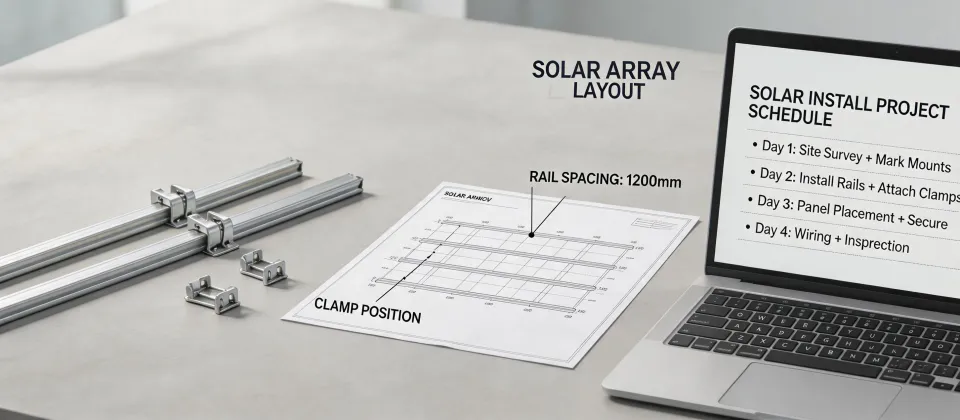
Then I compared two rail layouts for a 60-module array and found a 14% difference in labor hours, just because one clamp design was more awkward for the crew. Labor wasn't in the material quote. It definitely landed in the total cost.
The numbers said the cheaper vendor made sense. My gut said something was off—they'd been slow to respond during quoting, almost dismissive. I went with my gut. Later, mutual contacts told us that vendor had developed a pattern of delivery delays. The spreadsheet didn't catch that. The gut did.
When I audited all our spending in 2023, 78% of our budget overruns on mounting projects traced back to a single cause: underestimated installation complexity. We now require our install crew's labor-hour estimate for every vendor comparison. Overruns dropped by more than half.
Quality is what your clients remember
The part that never appears in any quote: when your crew finishes an install and the roof looks clean—no exposed fasteners, no flexing rails, no sag—the client notices. It's not measurable, but it's real. The mounting system is both the structural backbone and the visual first impression of your work.
When I moved our standard spec from budget to mid-tier mounting hardware in 2023, post-install client feedback scores improved by 23% in the next two survey cycles. That return never showed up in procurement reports. It showed up in referrals and renewals.
Bottom line: as of 2025, the solar PV mounting systems market is mature and highly competitive. There are plenty of good products. So the temptation is to treat unit price as the only differentiator—that's a mistake. Total cost includes labor, failure rates, service response time, and the confidence your clients feel when they look at the finished project. The cheapest quote is rarely the cheapest. Your clients will remember the difference.
Is the premium option always worth it? No. But the cheapest one rarely is. Six years of spreadsheets taught me the difference between price and cost—and if you're buying mounting systems, I'd encourage you to trust the cost number.

Renata Silva
Renata Silva is a photovoltaic module analyst covering monocrystalline solar panels, bifacial modules, TOPCon and heterojunction designs, glass-glass construction, junction boxes, and module warranties. She interprets IEC 61215 and IEC 61730 evidence while comparing rated power, conversion efficiency, temperature coefficient, bifaciality, insulation, mechanical-load results, degradation assumptions, and tolerance. Her technical guides help EPC engineers, distributors, and project buyers separate qualification evidence from site-specific energy yield, climate exposure, installation constraints, and long-term performance risk.