Why 'Good Enough' Solar Mounting Systems Are Actually Costing You More
2026-05-21 / Renata Silva
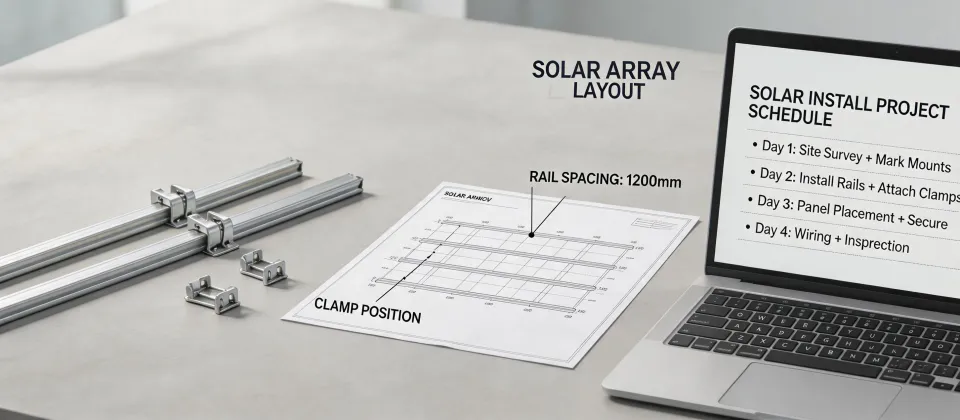
Let me be direct: if you're buying solar mounting systems based solely on the lowest price per watt, you're making a mistake I made myself about five years ago. The cheapest option is almost never the most cost-effective, and I've got the audit failures to prove it.
The Argument: A Low Bid Today Costs You More Tomorrow
I review roughly 200+ unique mounting system deliverables every year—specs, test reports, installation instructions. As of Q1 2024, I've rejected about 12% of first-round submissions from new vendors due to incomplete UL 2703 compliance documentation. That’s not a minor paperwork issue. That’s a structural problem waiting to happen.
My position is simple: efficiency isn't just about speed on the install site. It's about avoiding the drag that comes from using parts that barely meet the spec. Cut corners on the mounting hardware, and you introduce a cascade of inefficiencies that your team will pay for in hours, not dollars.
Evidence 1: The Hidden Cost of 'Compatible' Components
(Which, honestly, I wish someone had spelled out for me in my first year.)
A vendor once told me their roof mounting system was “fully compatible” with standard solar panel frames. They weren't lying. But 'compatible' meant the clamp had 2mm of adjustment range to accommodate a 35mm frame. Our panels were 32mm. Normal tolerance for a clamp is ±1mm. We were already pushing the edge before accounting for thermal expansion or install variance.
I said 'standard tolerance.' They heard 'it'll fit fine.' Result: we had to re-torque 200+ clamps on a single 50kW project six months later because the panels had shifted by 1.5mm. The cost of the re-torque call? About $2,200 in labor. The cost difference between the 'compatible' clamp and a properly specified clamp? About $0.30 per unit. Do the math on that.
Evidence 2: Automation in Spec Review Saves Real Time
Switching to a standardized digital checklist for our incoming product reviews cut our turnaround from 5 days to 2 days. Why does this matter to you? Because every day our engineering team waits for a submittal approval is a day the project isn't moving forward. More importantly, the automated process eliminated the data entry errors we used to have when someone manually transcribed a torque value from a PDF.
We're seeing the industry move in this direction—major EPCs are demanding digital submittals, not scanned PDFs, because a machine can check a torque spec against UL 2703 requirements in milliseconds. A human takes 45 seconds and maybe makes a typo.
Note: this doesn't mean we fire the reviewers. It means the reviewer spends those 45 seconds checking something the machine can't: whether the installation manual actually makes sense for the roofer on site. That’s where the value is.
Evidence 3: The 'Standard' That Wasn't
This one still frustrates me. In 2022, we received a batch of 8,000 mid-clamps. The spec called for 6005-T5 aluminum. The vendor shipped 6063-T5. To the untrained eye—look identical. But 6063 has a lower yield strength. The vendor claimed it was 'within industry standard' because, technically, some cheaper systems use it.
We rejected the entire batch. It cost the vendor a $7,000 redo and pushed our project timeline by two weeks. But here's the thing: if we hadn't caught it, those clamps would have been fine on a calm day. On a project in a 100-mph wind zone, they'd have been a failure waiting to happen. That's not 'within spec.' That's a gamble.
Answering the Obvious Objection
“But my budget is fixed. I need the lowest cost.”
I hear this a lot. And I get it—margins are tight. But ask yourself this: What is the cost of a single service call to replace a corroded bolt on a flat roof system? $500? $800? Now ask what the cost was of buying a bolt with proper corrosion resistance. $0.15 more per unit. The question isn't whether you can afford the better part. The question is whether you can afford the risk of the cheaper one across 500+ connections on a single project.
This isn't about luxury. It's about total cost of ownership (i.e., not just the unit price but all the hidden costs of delays, re-torques, and replacement). The 'cheapest' system often has a hidden 10-15% overhead in the form of project management headaches.
“But everyone else is using it.”
Are they? Or is the distributor just telling you that? I ran a blind test with our procurement team: same mid-clamp from three different budget vendors. Two had visible flashing on the edges (surprise, surprise), one had inconsistent anodizing thickness. The third was decent. Even within 'budget' options, there's a right way and a wrong way to choose.
Why This Matters for Solar Mounting Systems News
We’re seeing a push toward more efficient installations—pre-assembled rails, snap-in clamps, integrated grounding. These are good trends. But efficiency isn't just about the install speed of a ground mounting system. A fancy snap-in clamp that saves 2 minutes per panel isn't helping if it corrodes in year three or doesn't hold torque under thermal cycling.
I’ll say it plainly: a standardized, well-documented, UL-certified mounting system is a hedge against future project risk. Every hour you spend auditing a cheap system is an hour you're not spending on the things that actually improve your bottom line—like catching a mistake before it reaches the roof.
Final Thought (Not The Bottom Line)
I don't think cheap systems should be banned. There are projects—short-term installations, small off-grid solar systems—where the risk profile is different. But if you're building for a 25-year lifecycle, which most utility and commercial roof systems are, the mounting hardware is the least expensive place to cheap out and the most expensive place to get it wrong. You cannot replace a corroded rail without removing the solar panels on top of it.
So here's my view: optimize for efficiency of design and procurement, not price per unit. The efficient path is the one that gets you to year 10 without an expensive redo. That’s the definition of cost-effective for a PV rooftop system.

Renata Silva
Renata Silva is a photovoltaic module analyst covering monocrystalline solar panels, bifacial modules, TOPCon and heterojunction designs, glass-glass construction, junction boxes, and module warranties. She interprets IEC 61215 and IEC 61730 evidence while comparing rated power, conversion efficiency, temperature coefficient, bifaciality, insulation, mechanical-load results, degradation assumptions, and tolerance. Her technical guides help EPC engineers, distributors, and project buyers separate qualification evidence from site-specific energy yield, climate exposure, installation constraints, and long-term performance risk.