Ground vs. Roof vs. Flat Roof: Choosing the Right PV Mounting System for Your Site
2026-05-25 / Renata Silva
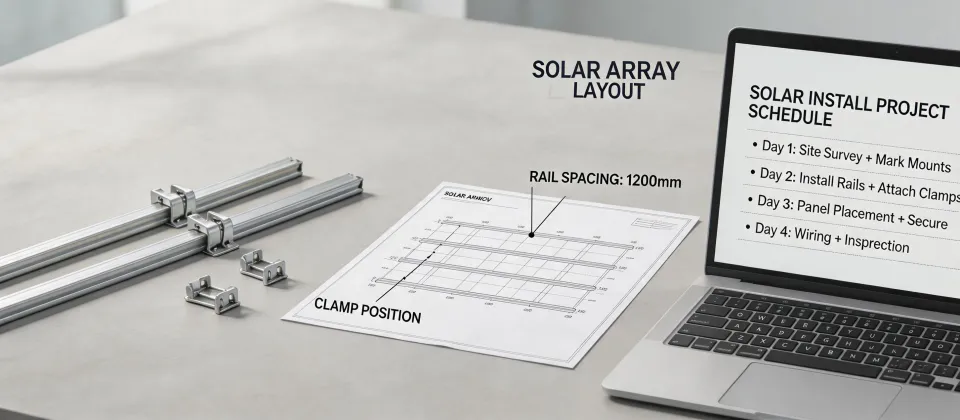
So, you're looking at mounting systems. And you've probably got three main options staring back at you: ground mount, roof mount, or flat roof mount. Maybe a carport too, if you're feeling fancy. The question isn't which one is 'best' — it's which one makes the most sense for your specific site.
I'm not a structural engineer, so I can't speak to load calculations for a specific building. What I can tell you is what I've seen across dozens of procurement cycles over the past six years for our solar projects. We've put up ground arrays, retrofitted sloped roofs, and ballasted flat roofs. I've tracked every invoice, change order, and lesson learned in our cost tracking system. About $1.8M in cumulative spending on structures and hardware alone.
Here's the core comparison framework I use internally when I'm deciding between them. It comes down to three dimensions: Total Installed Cost, Installation Speed & Complexity, and Future Flexibility. Let's put them head-to-head.
Dimension 1: Total Installed Cost (TCO)
This is where most people make a mistake. They look at the hardware price per watt and call it a day. But the hardware is often the smaller part of the equation.
Ground Mount:
- Hardware costs are lower per panel. You're buying aluminum rails and ground screws or concrete piers. For a 100kW system, figure on hardware being about $0.12-$0.15 per watt for a standard ground screw system.
- But you pay for site work. Grading, trenching for electrical, maybe a concrete pad for the inverter. In Q2 2023, we bid out a 150kW ground mount. The hardware was $18,000. The site prep was another $14,000. That's nearly double the cost just to put it in the ground.
- Permitting is often simpler, but you need land you own.
Roof Mount (Sloped):
- Hardware is more expensive per watt. You need flashings, rails, and attachments that don't compromise the roof. Expect $0.18-$0.22 per watt for a quality UL 2703-compliant system.
- Install labor is less intensive. No trenching, no concrete. But you're working at height, which adds safety costs and slows things down.
- The hidden cost? Roof replacement. If your roof is 10 years old, you're either paying to replace it now or taking a risk. We did a roof mount on a 40-year-old warehouse. The roof leaked 18 months later. $12,000 in repairs, plus we had to remove and reinstall 200 panels. That hurt.
Flat Roof Mount:
- Hardware cost is in the middle. Ballasted systems don't need roof penetrations (usually). You're paying for concrete blocks and racking. Expect $0.15-$0.18 per watt.
- Install is fast. No trenching, no roof work. Just stack the blocks and mount the panels. We had a 75kW flat roof done in 3 days with a 4-man crew.
- But the roof loading is real. You need a structural engineer to sign off. That's a cost you don't have with ground or sloped roof.
Honestly? For a simple greenfield site, ground mount wins on hardware cost. But if you factor in site work, the gap narrows. I've seen a ground mount budget blow up by 40% because of unexpected rock during trenching. Flat roof is the most predictable cost-wise, provided the roof can handle the load.
Dimension 2: Installation Speed & Complexity
Speed matters when you're trying to get a system online before a tax credit deadline or a utility interconnection window closes.
Ground Mount:
- Fastest to install if the ground is clear and flat. Ground screws can go in at a rate of about one per 10 minutes with the right equipment. For a 50kW system, I've seen the structure go up in 2 days.
- But complexity spikes with terrain. Sloped ground, rocky soil — you're suddenly in a civil engineering project.
- Access matters. If the site is a mile from the road, every truck of concrete or steel is a logistical headache.
Roof Mount (Sloped):
- Slower. You're working on a ladder, moving materials. A 20kW residential-style roof mount took us 4 days for a 5-man crew. Compare that to a ground mount of the same size which was 2 days with 3 guys.
- Safety is the bottleneck. Every fall protection plan adds time. And if the roof is steep (over 7/12 pitch), you're double-checking every step.
- Weather is a factor. Rain, wind, or snow means you're stopped. On a ground mount, you're at least on solid ground.
Flat Roof Mount:
- Winner for simplicity and speed. No roof walking. No fall protection gear aside from standard safety. The crew can stand on the roof and work.
- For a 100kW flat roof system, we ballpark 8-10 days for a 4-man crew. That includes moving equipment, laying out the ballast, mounting rails, and installing panels.
- The catch? You need a crane or a boom lift to get the materials up. That cost wasn't in our original quote for one job. Surprise $2,000 crane rental. So factor that in.
Here's the thing: I've never fully understood why rooftop installs are so variable. Some projects take twice as long as others for no obvious reason. My best guess is it comes down to the crew's familiarity with the roof type. A crew that only does ground mounts will be slow on a flat roof.
Dimension 3: Future Flexibility
This is the dimension most people ignore. They think 'I'm putting this up once and forgetting about it.' But things change.
Ground Mount:
- Most flexible. Want to add more panels? Buy more racking and screw it into the ground next to the existing array. We expanded a 100kW ground mount to 150kW by just adding 50kW of racking. Took a week.
- Need to move the array? You can unbolt the panels, unscrew the mounts, and move it. Not trivial, but doable.
- I'd argue ground mount is the best long-term asset if you have the land.
Roof Mount (Sloped):
- Least flexible. Adding more panels means finding more roof space. And if the roof is small, you're stuck.
- Roof replacement is the nightmare. Our earlier example with the warehouse? We had to disassemble the entire array, remove the racking, repair the roof, then reinstall. That was $8,000 in labor alone.
- So, roof mount is fine for a 20-year system life if the roof is new. But if the roof is 10 years old, you're gambling.
Flat Roof Mount:
- Medium flexibility. Adding panels means finding more roof space or adjusting the layout.
- Ballasted systems are actually easy to move if needed. You can slide the blocks and rails. But the roof layout is usually tight, so expansion is limited.
- A vendor once told me 'flat roof is the most money I've ever made on change orders.' That's because people don't think about future needs. If you plan for a 50kW system but might want 75kW later, buy the extra ballast blocks and racking now. It's cheap storage.
So, What Do You Choose?
Here's my no-nonsense decision tree:
Pick Ground Mount if:
- You own open, flat land with no shading.
- You want the lowest total cost of ownership for a system over 50kW.
- You're planning for future expansion.
- You don't mind the upfront site prep costs.
Pick Roof Mount (Sloped) if:
- You have a south-facing roof that's less than 10 years old.
- You're on a tight budget and hardware cost is your main concern.
- You have limited land.
- You are comfortable with the risk of roof replacement in 10-15 years.
Pick Flat Roof Mount if:
- You have a commercial flat roof with structural capacity for ballast.
- You need the fastest, most predictable install.
- You want no roof penetrations (to keep your roof warranty intact).
- Your roof is under 15 years old and has a good remaining life.
One more thing: That 'free consultation' from a vendor? It's not free. They're selling you their preferred solution. I've learned that the hard way. A vendor pushed a roof mount solution on us for a warehouse. When I dug into the numbers, the flat roof solution was $8,000 cheaper and would have been done in half the time. The vendor just didn't have flat roof inventory they wanted to move. So ask questions, get three quotes, and calculate your own TCO.

Renata Silva
Renata Silva is a photovoltaic module analyst covering monocrystalline solar panels, bifacial modules, TOPCon and heterojunction designs, glass-glass construction, junction boxes, and module warranties. She interprets IEC 61215 and IEC 61730 evidence while comparing rated power, conversion efficiency, temperature coefficient, bifaciality, insulation, mechanical-load results, degradation assumptions, and tolerance. Her technical guides help EPC engineers, distributors, and project buyers separate qualification evidence from site-specific energy yield, climate exposure, installation constraints, and long-term performance risk.