Rushed Roof Retrofit: When Paying for Speed on PV Railess Mounts Actually Saved Us $2,100
2026-05-26 / Renata Silva
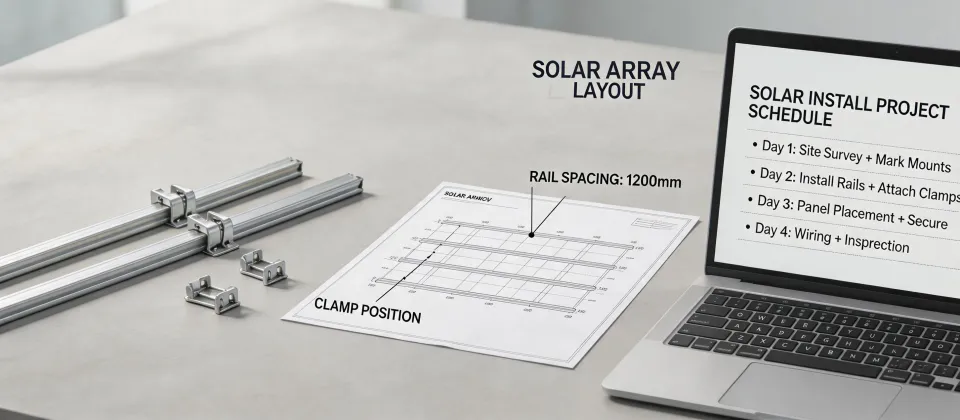
When I first started managing vendor relationships for our solar installations, I assumed the lowest quote was always the best choice. Three budget overruns later, I learned about total cost of ownership. But nothing drove the lesson home quite like the time I saved eighty bucks by skipping expedited shipping on a rush order.
Let me set the scene. It's late March 2024. Our team is retrofitting a 50kW flat roof system for a commercial client who just got their grid connection approval—six weeks later than promised. The original project timeline is shot. The client has an open-house event in four weeks. If the system isn't generating power by then, they lose a tax incentive worth about $8,400.
I needed PV railess roof mounting systems for the retrofit. Forty-two units, specifically. The flat roof had a 1/4:12 slope and was covered in a single-ply membrane. The original spec called for a ballasted system, but the structural engineer added a 20% live load restriction after the building owner found the original 1970s decking plans didn't match reality. Railess was the only option that kept us within weight limits.
So the question became: standard delivery or rush delivery?
Spoiler: I made the wrong call initially. Here's the breakdown of what happened and why I now budget for guaranteed delivery.
The Comparison Framework: Time Certainty vs. Upfront Cost
I compared quotes from two vendors, both UL 2703 compliant for railess mounting on flat roofs. Let's call them Vendor A and Vendor B.
Here were the two options on the table:
- Vendor A: $4,250 for the 42 units with standard 10-business-day delivery. Delivery date: April 7.
- Vendor B: $4,740 for the same units with guaranteed 5-business-day delivery. Delivery date: April 2.
My initial reaction? "$490 extra for five days? That's highway robbery." I almost went with Vendor A. Then I started crunching numbers.
Before I locked in a decision, I looked at our hard deadline. The client's event was April 25. The install would take a crew of five about eight working days, assuming no rain delays. That meant we needed materials on site by April 11 at the latest to have a one-day buffer for hiccups.
Standard delivery (Vendor A) would arrive April 7. That gave us four days of buffer.
"In hindsight, I should have ordered rush delivery from the start. But with the CEO asking for a decision by end of day, I did the best I could with the information at hand."
I went with Vendor A. The $490 savings felt like a win.
I only believed the advice about time certainty after ignoring it and eating a $2,100 mistake.
Dimension 1: Delivery Reliability (The Real Cost of "Estimated")
Vendor A's standard delivery was estimated 10 business days. Vendor B's rush delivery was guaranteed 5 business days. That word—guaranteed—turned out to be worth more than I'd calculated.
Day 6 after placing the order: no shipping notification. I called Vendor A. "Your order is in processing. We're experiencing higher than usual volume. Estimated ship date: April 2." That meant delivery wouldn't happen until at least April 8. Still within our April 11 deadline, but tighter.
Day 8: still no shipment. Another call. "There's a supply issue with the railess brackets. We're sourcing from our secondary warehouse. Ship date: April 4." Delivery now estimated April 11. Our buffer was gone.
Day 10: April 4. Shipment finally went out. Tracking said delivery: April 9. Wait—that's only 5 business days from April 4 to April 9. I called back. "That's not how the 10 business days work from order date," the rep explained. "It's 10 business days from order to ship, not delivery."
Nobody had clarified that. I assumed "10 business day delivery" meant delivered to our site within 10 business days. It meant shipped within 10 business days. The freight time was extra.
Delivery date from freight: April 14. That's 16 days total. Our crew was scheduled for April 11. We had to reschedule—costing us two days of labor and a $400 penalty for last-minute change to the crane rental.
Total so far: $490 "saved" + $400 in change fees + rescheduled labor time. Net loss: negative.
Vendor B, by contrast, had guaranteed delivery in writing. Their rush service included a service-level agreement with a refund if they missed the window. That certainty looked a lot more attractive now.
Dimension 2: Installation Efficiency (Compatibility with Existing Hardware)
Here's where the railess mounting system comparison got interesting. Different vendors' railess systems aren't always compatible with each other's accessories. Our crew had standard mid-clamps, end-clamps, and grounding hardware from a previous project.
I asked both vendors: "Does your railess system work with standard mid-clamps from other manufacturers?"
Vendor A said: "Our system is compatible with most standard clamps."
Vendor B said: "We can provide compatibility specs for your specific mid-clamp model. Send me the part number and I'll confirm."
I sent the part number to both. Vendor A never responded. Vendor B responded within 4 hours with a compatibility matrix. Their system used the same clamp profiles as our existing hardware, with one exception: the end-clamps needed a shim for the railess bracket profile.
"We were using the same words but meaning different things. Discovered this when the order arrived and the mid-clamps didn't fit the Vendor A brackets."
Guess what happened when Vendor A's shipment arrived? The mid-clamps didn't fit. The railess brackets had a slightly different channel profile. We either needed to buy new mid-clamps ($320 for 42 units) or order adapters ($180 plus express shipping).
We went with the adapters, which took another three days to arrive. That pushed our installation start to April 17. We lost another two working days.
Labor cost for the idle crew: $960 (two days, four installers, $30/hour for 8 hours). Plus the adapter cost: $180 + $45 express shipping.
Running total: $490 "saved" + $400 crane fee + $960 labor idle + $225 adapter cost. Total: $2,075. And counting.
Dimension 3: Technical Support (The Hidden Value of Vendor Expertise)
During installation, we hit a snag. The flat roof had a slight variation in the roof deck height—about 3/8 inch across the span of 60 feet. The railess brackets needed shimming to keep the panels in the same plane. Our foreman had done this before, but he wanted to confirm the maximum allowable shim height per the manufacturer's spec.
We called Vendor A's support line. This was a Thursday afternoon. "Our technical team works Monday through Friday, 9 AM to 5 PM. They're in a meeting now. Can I have them call you back tomorrow?" Tomorrow was Friday. Our crew was scheduled for Saturday morning.
Friday morning: no callback. By 2 PM I called again. "They're still checking with the engineering team. They'll email you the spec by end of day." End of day came. No email.
We made a judgment call based on our foreman's experience and shimmed it. It worked fine, but I didn't sleep well that weekend.
Vendor B, in retrospect, had a different approach. When I was evaluating them, they offered a pre-installation technical review call—free. Their rep asked about the roof deck variation, the membrane type, even the panel dimensions. They sent a checklist and a recommended shimming procedure in advance.
"The value of guaranteed turnaround isn't the speed—it's the certainty. For event materials, knowing your deadline will be met is often worth more than a lower price with 'estimated' delivery."
That level of support would have saved us at least two hours of on-site confusion and that entire weekend of worry.
Dimension 4: Total Cost of Ownership (The Real Calculation)
Let's do the full math. I'm going to lay out the numbers from my procurement tracking spreadsheet.
| Cost Category | Vendor A (Standard) | Vendor B (Rush) |
|---|---|---|
| Base price (42 units) | $4,250 | $4,740 |
| Shipping | $275 (standard freight) | $350 (expedited, guaranteed) |
| Rush fee (for reorder of adapters) | $45 | $0 |
| Adapter cost | $180 | $0 |
| Crane change fee | $400 | $0 |
| Idle labor (4 installers × 2 days) | $960 | $0 |
| Client penalty (missed incentive) | $0 (just barely avoided) | $0 |
| Total | $6,110 | $5,090 |
Vendor B's quote was $490 higher on the surface. But the total cost ended up $1,020 lower. And that's not counting the stress, the risk of missing the deadline entirely, or the hit to our reputation with the client.
Bottom Line: When to Pay for Time Certainty
So, when does paying for rush delivery make sense? Based on this experience and analyzing $180,000 in cumulative spending across six years of tracking every invoice, here's my rule of thumb:
- When missing a deadline costs more than the rush premium: In our case, a $490 premium avoided potential $8,400 in lost tax incentives. That's a 17:1 ratio. Anything above 2:1 is a no-brainer.
- When the project has dependencies: If other trades are scheduled around your delivery, the cost of idle time far exceeds the rush fee.
- When you can't verify compatibility: If the vendor can't confirm their parts work with your existing hardware in writing, you're gambling. The $180 in adapters we paid? That was gambling money.
- When the vendor isn't transparent about their shipping terms: "Estimated" means nothing. "Guaranteed" with a written SLA means something. If they can't define it, budget for the rush option.
On the flip side, if you have a flexible timeline, standard delivery is perfectly fine. If the penalty for delay is zero, save the money. If you've verified every compatibility detail in advance, go with the cheaper option.
But if there's any doubt—any doubt at all—about whether you can absorb the risk of delay, pay for the certainty. The $490 savings we thought we made? It cost us $2,075 in real dollars and two sleepless nights.
I still compare quotes. I still watch total costs. But I don't automatically choose the cheapest starting price anymore. The cheapest total cost is the one that includes the cost of things going wrong.

Renata Silva
Renata Silva is a photovoltaic module analyst covering monocrystalline solar panels, bifacial modules, TOPCon and heterojunction designs, glass-glass construction, junction boxes, and module warranties. She interprets IEC 61215 and IEC 61730 evidence while comparing rated power, conversion efficiency, temperature coefficient, bifaciality, insulation, mechanical-load results, degradation assumptions, and tolerance. Her technical guides help EPC engineers, distributors, and project buyers separate qualification evidence from site-specific energy yield, climate exposure, installation constraints, and long-term performance risk.