How to Vet Solar Mounting Systems: A Practical 5-Step Checklist for Your Next Project
2026-05-19 / Renata Silva
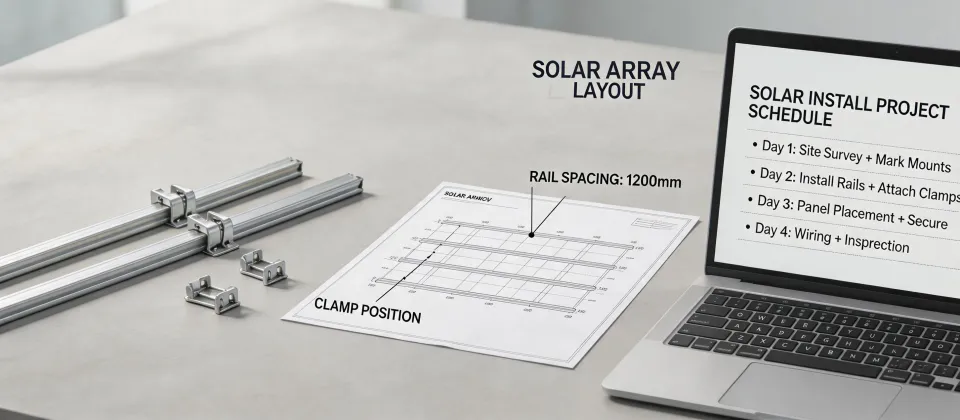
If you're sourcing mounting systems for a commercial or residential solar project—whether it's a flat roof ballasted setup, a ground mount array, or a carport structure—the decision often comes down to specs vs. promises. I've reviewed over 200 unique mounting system deliveries annually for four years, and I've seen the same issues repeat. So here's a direct checklist. No fluff. If you're responsible for procurement or project management, this is the process I'd use.
When to Use This Checklist
This is for when you have a shortlist of 2-4 mounting system suppliers and need to move from paper specs to a reliable choice. It's not for exploratory research. You've already narrowed down based on system type (ground, roof, flat roof, carport) and general cost. Now you need to validate.
Step 1: Verify Compliance Claims (Don't Just Trust the Marketing)
Every supplier will say they meet UL 2703 or local equivalent. The question is: can they prove it? I'm not a testing engineer, so I can't speak to the nuances of fire rating tests. What I can tell you from a quality management perspective is that compliance documentation is often incomplete.
What to check:
- Ask for the test report number, not just a certificate. A UL 2703 listing should have a corresponding file number you can verify on UL's Product iQ database.
- Does the report cover your specific module brand and model? Compatibility varies. One supplier's 'works with all standard modules' claim (which, honestly, is a red flag) might not include the thicker framed bifacial panels you plan to use.
- Are the reports current? Standards get updated. A report from 2019 might not cover a 2023 standard revision.
Why does this matter? Because a compliance gap can stop a project during permit review. In Q1 2024, we rejected a batch of 500 roof hooks because the dealer-supplied compliance documentation didn't match the product. The vendor claimed it was 'within industry standard.' We rejected the batch, and they redid it at their cost. Now every contract we write includes a clause tying milestone payments to verified compliance documentation.
Step 2: Inspect the Material Specs—Look Beyond 'Galvanized Steel'
It's tempting to think that 'galvanized' is all the same. But the corrosion resistance difference between a G90 hot-dip galvanized finish and a G60 pre-galvanized finish is significant, especially for ground mounts near coastal areas. The simplified 'all galvanized is good' advice ignores coating thickness, application method, and cut-edge protection.
Verify three things:
- Coating spec: Request the mill certificate or a third-party test report for coating thickness (ASTM A123 for hot-dip, A653 for sheet). Don't accept 'meets industry standard.' Specify the minimum coating weight (e.g., G90 = 0.90 oz/ft²).
- Material grade: For structural components like rails and support posts, you want a minimum of ASTM A36 structural steel or equivalent. Aluminum alloys should be 6005-T5 or 6061-T6 for adequate strength. I've seen suppliers substitute 6063-T5 for cost reasons—it's weaker, especially in longer spans.
- Cut edges: Pre-galvanized sheet has exposed steel on cut edges that can rust within 6-12 months in a humid environment. Does the supplier offer edge sealant or touch-up paint? If not (surprise, surprise), you'll deal with rust trails on your white roofing membrane.
People think expensive vendors deliver better material grades. Actually, vendors who consistently deliver specified grades can charge more. The causation runs the other way. Don't assume price equals material compliance.
Step 3: Evaluate Installation Complexity—Design for an Average Crew
The assumption is that all mounting systems install the same way. The reality is that installation complexity varies hugely (Source: based on our project feedback from over 50 installations).
Three things to ask:
First, does the system require precision field-cutting of rails, or are lengths pre-cut to the design? Field-cutting structural aluminum requires proper tools and training. If your average crew is good at electrical work but less experienced with mechanical fabrication, a pre-cut system is a no-brainer.
Second, what is the fastening complexity? A system with 30 unique fastener types is way more of a headache than one with 5 standard types. More fasteners means more inventory risk, more dropped bolts, and more rework.
Third, do they provide clear, project-specific engineering and installation drawings, or do they supply 'generic instructions'? I ran a blind test with our installation team: same roof layout with generic instructions vs. project-specific stamped drawings. 80% identified the specific drawings as 'more professional' without knowing the difference. The cost increase from the supplier was 0.3% per piece. On a 50,000-unit annual order, that's a small price for measurably better installation certainty.
Step 4: Evaluate Total Cost—Not Just the Unit Price
The lowest quoted price for the mounting system itself is almost never the lowest total project cost. This gets into project management territory, which isn't my primary expertise. What I can tell you from a procurement perspective is to account for:
- Shipping: Ground mount piles and long roof rails are long, heavy items. A 20% cheaper supplier 800 miles away might cost more in freight than a local supplier with slightly higher unit pricing.
- Ancillary parts: Does the base price include all clips, splices, grounding lugs, and end caps? Or are those line items? I've seen a 'cheap' system end up 15% more once all required hardware was added.
- Lead time: A 3-week lead time vs. a 6-week lead time can change your project schedule by a month. What's the cost of that delay?
Why do rush fees exist? Because unpredictable demand is expensive to accommodate. If you need a system in 4 weeks and one supplier can deliver in 3, and another in 6, the faster one might be worth a premium.
Step 5: Check Reference Projects—Preferably for a Similar Scale
A supplier who does great work on a 100-module residential roof might not have the production capacity or quality process for a 10,000-module ground mount farm. I don't have hard data on industry-wide failure rates of small-by-large suppliers, but based on our 5 years of orders, my sense is that compatibility issues affect about 8-12% of first deliveries when system scale mismatch is present.
Ask for:
- References for projects within 50% of your system size (e.g., if your system is 500 kW, ask for 300-750 kW project references).
- Photos of completed projects (not just marketing renders). Look for quality of attachment, wire management, and seam transitions.
- A conversation with their engineering support team. Are they responsive to technical questions? We called 4 suppliers with a simple spec question about roof attachment spacing for a flat roof system. Two responded within 24 hours with a detailed answer. One responded in 72 hours with 'our standard spec.' One didn't respond at all. Guess which ones we dropped?
Common Pitfalls to Avoid
1. The 'All-in-One' Promise — A supplier claiming their system works with 'all solar panels without exception' is overpromising. Module dimensions, frame thickness, and weight vary. Anyone who's ever tried to fit an oversized frameless module into a standard clamp knows this.
2. Overlooking Grounding — Roof and ground mounts require proper bonding pathways. Ensure the system has listed grounding components that are compatible with your module frame. A missing grounding clip can fail an entire inspection.
3. Assuming Zero Maintenance — No mounting system is maintenance-free. Ballasted flat roof systems need annual seam and membrane checks. Ground mounts need vegetation management and fastener torque checks. Factor this into your long-term cost model.
4. Ignoring Modularity for Small Projects — If you're starting with a smaller pilot system (say, a 50-module carport), look for a supplier who offers the same core rail and clamp components for larger systems. When I was managing a $20,000 pilot install, the vendors who treated my order seriously are the ones I still use for $200,000 orders. Small doesn't mean unimportant—it means potential.
Prices as of January 2025; verify current rates and certifications directly with suppliers. For specific compliance requirements, consult your local building authority or a structural engineer.

Renata Silva
Renata Silva is a photovoltaic module analyst covering monocrystalline solar panels, bifacial modules, TOPCon and heterojunction designs, glass-glass construction, junction boxes, and module warranties. She interprets IEC 61215 and IEC 61730 evidence while comparing rated power, conversion efficiency, temperature coefficient, bifaciality, insulation, mechanical-load results, degradation assumptions, and tolerance. Her technical guides help EPC engineers, distributors, and project buyers separate qualification evidence from site-specific energy yield, climate exposure, installation constraints, and long-term performance risk.