I Saved 18% on Solar Mounting Systems. It Cost Me $13,400.
2026-08-21 / Renata Silva
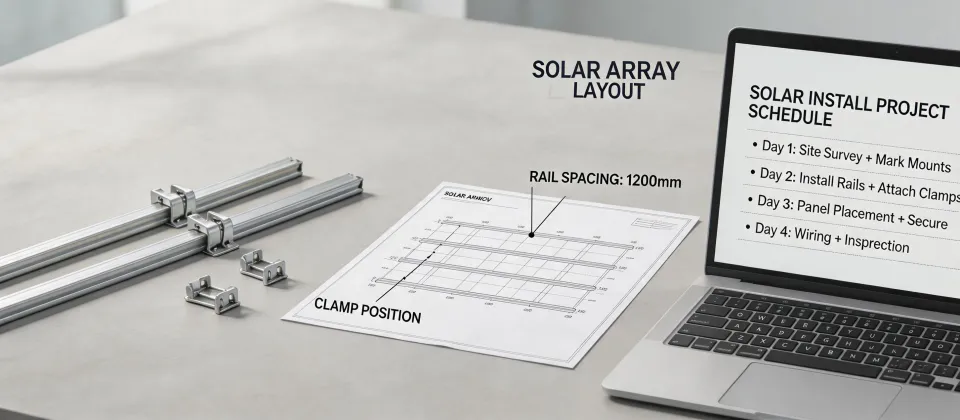
In March 2023, I approved a purchase order for what looked like the deal of the year. A flat-roof solar mounting system, 280 kW, commercial rooftop. Four vendors quoted. The winner came in 18% below the next-lowest bid. I remember thinking, finally, someone who isn't padding their margin.
By October, that "bargain" had cost us $13,400 in rework, replacement parts, and delay penalties. The final bill landed higher than if we'd accepted the next-lowest quote and done absolutely nothing else.
I'm the procurement lead at a mid-size EPC firm. I've been handling mounting system and BOS orders for seven years. I've personally made — and documented — 23 significant mistakes, totaling roughly $187,000 in wasted budget. Now I maintain our team's pre-order checklist so nobody repeats my errors. This is the story of the worst one.
The quote that looked too good to question
The project itself was unremarkable. 280 kW flat-roof commercial array, ballasted mounting system, standard 400 W panels, no rooftop access drama, no unusual wind zone. I'd built a dozen like it. The only unusual thing was the quote.
Eighteen percent below the closest competitor. Same rail material on the spec sheet — extruded aluminum 6005-T5. Same clamp count. Same ballast approach, roughly. I wasn't a rookie taking numbers at face value. I checked that sheet twice. Actually, three times.
I called the rep about lead times. I asked about rail profile dimensions. I asked about torque specs — the roof/wind interface where cheap systems reveal themselves. He answered everything. Or so I thought.
Here's the thing: I asked the right questions to the wrong person. The spec sheet looked right because spec sheets always look right. The real test happens on the roof, in the wind, with a torque wrench in your hand and a rail splice that doesn't line up.
That's where it fell apart.
Why this keeps happening
The deeper problem isn't that one vendor let me down. It's the market we're all buying into.
The solar PV mounting systems market size is enormous and still climbing. I'm not going to hand you a fake-precise number, because analyst reports disagree depending on how they define "mounting system." Every credible source I've read — Grand View Research, Wood Mackenzie, various industry roundtables — puts it in the double-digit billions, growing at high single digits or better. Growth like that attracts vendors. And vendors competing for volume get optimistic about what their hardware can survive on a real roof.
Aluminum is not one thing
Both quotes said "aluminum 6005-T5." Identical chemistry, right? Not quite. There's a difference between structural-grade extrusion with verified temper and a profile that meets minimum chemistry but skips the verification. One handles decades of thermal cycling and uplift loads. The other develops hairline cracks at splice points. You cannot see the difference in a PDF. You see it on the roof, in year three, when the racking moves a little more than it should.
I'm not naming a villain brand — a client asked me to review an ALUMIL solar mounting systems alternative last year, and I checked it the same way: rail profile, clamp compatibility, material grade, torque spec. ALUMIL makes solid products. The point is no brand decision saves you from verifying the spec against your actual site. A brochure is a marketing document, not a structural guarantee.
Electrical was an afterthought. That was the real sin.
The mounting system was half the order. The BOS list also included inverters, surge protectors, and the usual electrical accessories. I priced them together. I did not plan them together.
I remember a junior installer asking me, "can I use a surge protector with an extension cord?" for temporary site power. Fair question — the answer depends on cord gauge and load. But the question itself exposed the mindset: electrical protection was an afterthought. We'd already started bolting rails before deciding where the surge protection would live. The racking dictates where inverters sit, where DC runs route, where protection has to go. If you discover those answers on install day, everything costs double.
Discipline I should have carried over
Earlier in my career I sourced components for a defense contractor — military power inverter assemblies, among other things. Those contracts had zero tolerance for ambiguity. Every component had traceability. Every deviation was documented and signed. I used to think that was bureaucracy for people who didn't trust their suppliers.
I was wrong. It's a firewall. The IT team on our projects runs a firewall monitoring system that flags anomalies before they become breaches. Procurement needs the same logic: a gate that catches a small anomaly before it compromises the whole job. In 2023, I had no firewall. I had a stack of PDFs and a sales rep who sounded confident.
The real price tag
Let me show you what "cheap" actually costs. From our project ledger, Q1 through Q4 2023:
- Original purchase order: $38,600
- Replacement clamps — the rail profile was close, but not close enough; one batch failed torque testing on site: $4,200
- Re-engineered ballast layout — the wind uplift calc had a bad parapet assumption: $3,100
- Surge protector relocation — first install was mounted to a structure never designed to carry it: $1,800
- Liquidated damages from the two-week schedule slip: $3,600
- Internal labor — team re-reviewed the whole BOS, plus my own hours: $700
Total additional cost: $13,400.
Grand total: $52,000.
The quote we turned down: $47,100.
We spent $4,900 more for the honor of being the smart buyer.
And the kicker — panels that could have been exporting power in July came online in August. I don't have a line item for that, but I know it wasn't zero.
Here's the part that still bothers me. The spreadsheet said Vendor B. My gut said the sales rep had dodged my torque spec question twice — "we'll send that over" never arrived. I went with the spreadsheet. The gut was right. I do not ignore that feeling anymore.
The lowest quote is not a price. It's a risk profile that hasn't priced itself in yet.
One caveat on the numbers: they were accurate for our purchase in 2023. Material markets have moved since, so verify current rates before you budget. The categories matter more than the decimals — every project carries these cost buckets. You just don't see them until they're billed.
What I do now: the TCO checklist
After the third rejected shipment in Q1 2024, I built our pre-order checklist. It's not a 40-page manual. Four questions:
- Have I calculated total cost, not just unit price? Include freight, tooling, torque verification, the realistic chance of rework, and the project's actual delay penalty. If the "saving" is smaller than the delay risk, it's not a saving.
- Have I verified the physical spec against the site plan? Not against the brochure. Against the drawings. Rail profile, clamp compatibility, wind uplift calcs, material temper. Get it in writing.
- Have I planned the electrical integration before ordering the racking? Where do the inverters sit? Where does the surge protection live? Where do the DC runs route? Answer before the steel leaves the factory.
- Can the vendor give me a reference I can call? Not a PDF testimonial. A person who has installed it and will answer the torque question the sales rep dodged.
Since Q1 2024, those four questions have caught 47 potential problems. Some were small — a mismatched clamp assortment that would have burned a week of reordering mid-install. One was a ballast layout that wouldn't have survived the first real wind event. We caught it on paper, not after the panels were torqued down.
Look, I'm not saying a lower-priced system is automatically a trap. I'm saying you can't know until you've done the math and the verification. That takes an afternoon. Rework takes a quarter.
Next time you're staring at two quotes — one 18% cheaper, both claiming 6005-T5 — ask which one has the torque spec in writing. The cheap one probably doesn't. That's not a coincidence. Now it's not a lesson you have to pay for either.

Renata Silva
Renata Silva is a photovoltaic module analyst covering monocrystalline solar panels, bifacial modules, TOPCon and heterojunction designs, glass-glass construction, junction boxes, and module warranties. She interprets IEC 61215 and IEC 61730 evidence while comparing rated power, conversion efficiency, temperature coefficient, bifaciality, insulation, mechanical-load results, degradation assumptions, and tolerance. Her technical guides help EPC engineers, distributors, and project buyers separate qualification evidence from site-specific energy yield, climate exposure, installation constraints, and long-term performance risk.