Rush Solar Project Field Guide: Mounting Systems, Battery Specs, and Safe Disconnects
2026-08-20 / Renata Silva
-
Who This Is For
-
Step 1: Lock Down Solar Panel Flat Roof Mounting Systems Before You Promise a Date
-
Step 2: Battery Energy Storage System Specification: The Minimum Checklist
-
Step 3: How Do You Disconnect a Car Battery? And Why the Order Matters
-
Step 4: Verify the Things Everyone Assumes Are Fine
-
Step 5: Build a 48-Hour Buffer Into Every Deadline
-
What Not To Do
-
Looking Back
Who This Is For
This is for solar project managers and field crews who get handed a deadline that shouldn't exist. I work at Mounting Systems, a solar mounting company, and my job is to keep emergency orders moving. I have handled 200+ rush orders in eight years, including same-day turnarounds for EPCs and commercial clients.
If you're tracking the South America solar PV mounting systems market, you know the feeling. Projects are multiplying, timelines are getting tighter, and there is no room for a mis-shipped rail or a wrong battery connector. This checklist is what I run through when the clock is ticking.
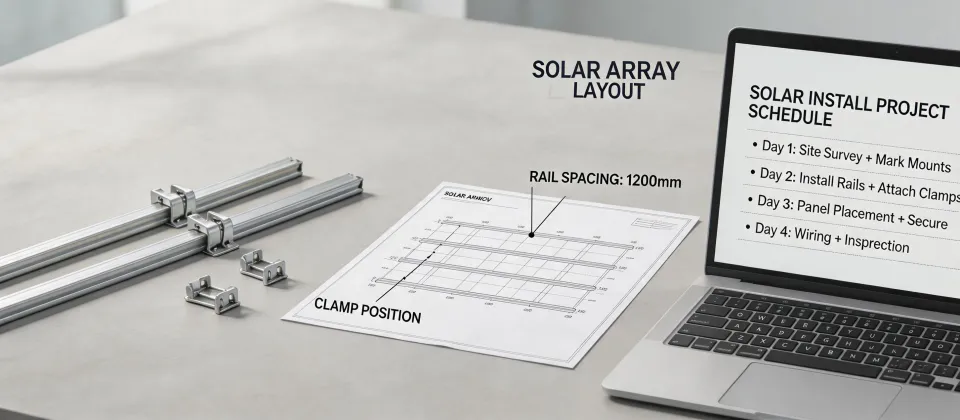
Step 1: Lock Down Solar Panel Flat Roof Mounting Systems Before You Promise a Date
The fastest way to miss a deadline is to start with a vague specification. Solar panel flat roof mounting systems have two basic approaches: ballasted and penetrated. Ballasted systems are faster to install, but they add a lot of load to the roof. Penetrated systems give you more wind resistance, but they need roof work and waterproofing. There is no universal winner. The right choice depends on the roof, the local code, and the building engineer's comfort level.
Before you order anything, you need answers to these questions:
- What is the roof membrane? Single-ply membranes usually favor ballasted systems.
- What is the wind uplift requirement? High wind zones are common in coastal South America. Extra ballast or a top-speed clamp is not optional.
- What is the roof slope? A 5-degree slope needs a different tilting system than a flat deck.
- What are the exact module dimensions? Not the datasheet nominal size, but the actual dimensions and clamp location.
- What accessories are required? Cable management, flashing, snow stops if relevant.
I made the classic specification error in my first year: assumed a standard rail profile would fit a module that was 20mm wider. Cost me a full rework, a freight charge, and a client's trust. That mistake is why I now ask for the module cut sheet before I promise a lead time.
Step 2: Battery Energy Storage System Specification: The Minimum Checklist
A battery energy storage system specification is not 'around 100 kWh.' It is a contract between the engineering team and the supplier. If it's vague, you inherit the risk. The supplier who is honest about what they can and cannot support is worth more than one who says 'we can make anything work.'
Before approving a system, I need at least these items:
- Nominal voltage and usable capacity
- Continuous power and peak power with duration
- Depth of discharge limit
- Round-trip efficiency
- Chemistry: LFP, NMC, or lead acid solar battery
- Operating temperature range
- Enclosure protection rating
- Warranty conditions and throughput limits
- Communication protocol and compatibility with the inverter
- The intended operating mode: peak shaving, backup, self-consumption, or grid services
(Should mention: this list is not a design guide. It's the starting point for a real engineering review.)
One thing I should add: lead acid solar battery systems still work well for certain off-grid and backup applications. But they need ventilation, temperature compensation, and the right charging profile. If you treat them like lithium, you will cut cycle life fast. The 'lead acid is always cheaper' thinking comes from an era when lithium was expensive and charging systems were simpler. That has changed.
Step 3: How Do You Disconnect a Car Battery? And Why the Order Matters
The question 'how do you disconnect a car battery' sounds basic. But I've watched experienced installers go straight for the positive terminal. That is wrong. In a car, the order is always the same:
- Turn off the engine and remove the key.
- Disconnect the negative terminal first.
- Then disconnect the positive terminal.
- When reconnecting, connect positive first, then negative.
Why negative first? The negative terminal is bonded to the chassis. If your wrench touches metal while you work on the positive side, you create a short circuit. Taking off the negative first breaks that path.
For a lead acid solar battery in a 12V or 24V off-grid system, the same principle applies. Disconnect the PV source, then the load, then the battery terminals. If you are working with a larger battery energy storage system, do not rely on a general article. Get the manufacturer's service manual, follow the lockout/tagout procedure, and use a qualified electrician. I'm not an electrical engineer, and I'd rather lose a deadline than watch someone get hurt. That is the boundary I don't cross.
Step 4: Verify the Things Everyone Assumes Are Fine
On a rush timeline, the small stuff fails you. The step most installers skip is verifying the mounting system parts with the actual components.
I once ordered a bracket from a discount supplier to save $200. The bolt holes were 1.5mm off. We spent $1,200 in labor adjusting the install. At least, that's been my experience: discount parts cost more than the money they save.
A quick pre-install checklist:
- Use a torque wrench on rail clamps. 'Hand tight' is not a torque spec.
- Check that the clamps actually fit the module frame. A clamp that looks right can still be 2mm short.
- Check the battery terminal type. Lead acid solar battery terminals come in multiple sizes. The wrong size means sparks and rework.
- Check inverter communication protocol before energizing. 'It should talk to that BMS' is not a plan.
Step 5: Build a 48-Hour Buffer Into Every Deadline
In the South America solar PV mounting systems market, logistics are not always predictable. A shipment can sit in customs for another day. A truck driver can get delayed at a border crossing. If you schedule the exact day, you're making a bet you'll probably lose.
In March 2024, a client called on a Wednesday afternoon. They needed the mounting system for a flat roof project by Saturday morning. Normal lead time was five days. We found a way to ship direct from the warehouse, paid extra for a pallet truck, and delivered Friday night. The client's alternative was breaching a penalty clause that would have wiped out their profit.
We delivered because the plan included a buffer from the beginning. If you don't have a buffer, you're not telling the client the truth—you're telling them a best-case story. Best-case is not a plan.
What Not To Do
- Don't commit to a mounting system without a wind load calculation.
- Don't buy a battery energy storage system without a specification sheet.
- Don't disconnect any battery in a random order. Use the manufacturer's sequence.
- Don't assume all modules work with your rail clamps.
- Don't ask a supplier to be your engineer. If they don't know the answer, run.
The vendor that says 'this isn't our strength' actually understands the boundary. That vendor is easier to trust than the one who promises everything.
Looking Back
If I could redo my early rush projects, I'd spend more time on specifications and less time on heroics. I should have written better checklists and asked harder questions. But given what I knew then, my choices made sense. The good news is that a rush job doesn't have to be chaotic. It's just a normal project with less slack.
Not ideal, but workable. And a lot better than missing the deadline.

Renata Silva
Renata Silva is a photovoltaic module analyst covering monocrystalline solar panels, bifacial modules, TOPCon and heterojunction designs, glass-glass construction, junction boxes, and module warranties. She interprets IEC 61215 and IEC 61730 evidence while comparing rated power, conversion efficiency, temperature coefficient, bifaciality, insulation, mechanical-load results, degradation assumptions, and tolerance. Her technical guides help EPC engineers, distributors, and project buyers separate qualification evidence from site-specific energy yield, climate exposure, installation constraints, and long-term performance risk.