Solar Mounting Systems: 7 FAQs from a Guy Who's Triaged 200+ Rush Projects
2026-05-27 / Renata Silva
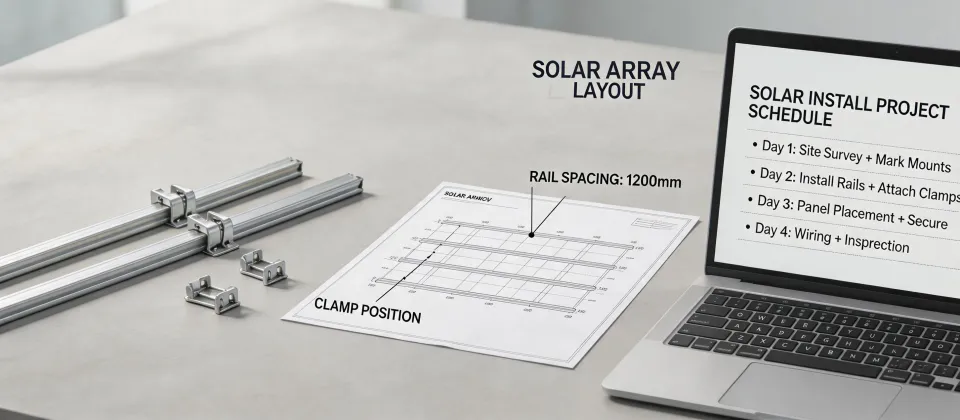
You're here because you need mounting systems. Maybe for a commercial ground mount. Maybe for a tricky flat roof. Maybe it's a tight timeline—story of my life, actually.
In my role coordinating procurement for a solar equipment supplier, I've handled over 200 rush orders in the last 4 years. Some for warehouse rooftops, some for carports, and a memorable one where a client needed ground mounts delivered in 48 hours for a utility project with a serious penalty clause.
This is a straight-shooting FAQ. No marketing fluff. Just answers to what I get asked weekly.
1. Do I need a ground mount, roof mount, or flat roof mount?
Short answer: It's about the site, not what looks cool.
Your installer should be telling you this, but here's the cheat sheet I use when triaging orders:
- Ground mount: You have open land. Need to optimize tilt angle. Want lower cost per panel. Best for large commercial or utility-scale.
- Roof mount (sloped): You have a pitched roof with good orientation. Saves land space. Can be cheaper on materials but might be trickier to install.
- Flat roof mount: Ballasted or penetrated systems. Critical load and wind calculations. I've seen flat roof systems fail because someone didn't factor in snow drift. Don't be that guy.
- Carport: Dual-use space. Shade + power. Premium cost, but adds value for parking lots.
I'm not 100% sure about every single scenario, but if you're dealing with a flat roof over 10 years old, get a structural engineer involved. Trust me on this one.
2. What's the deal with UL 2703 compliance?
Don't skip this. Seriously.
UL 2703 is the standard for mounting systems and racking in North America. It covers grounding, bonding, and mechanical loading. If your mounting system isn't UL 2703 listed, your insurer might not cover you. I've seen a 50-panel system get red-tagged because the clamps weren't listed.
Here's something vendors won't tell you: some 'UL compliant' products only cover the rail, not the clamps. You need to check the entire assembly. We verify this on every order we ship, and it's a non-negotiable in our procurement process.
3. How do I choose between aluminum and steel mounting?
People think steel is stronger than aluminum. The assumption is that stronger material means a better system. The reality is aluminum is plenty strong for most applications, and it doesn't rust. Steel can be cheaper per pound, but you factor in galvanization costs and weight.
I spent 2 years going back and forth. Every cost analysis pointed to steel. But my gut said stick with aluminum for coastal projects. Went with my gut after a client told me about their rust issues on a beachfront installation. Turns out that 'cheaper' steel with bad coating was a preview of expensive warranty claims.
Quick rule:
- Aluminum: Lightweight, corrosion-resistant, higher upfront cost
- Steel (galvanized): Stronger, cheaper per panel, but heavier and can rust if coating fails
4. What's a realistic timeline for ordering mounting systems?
People think you can call and get mounting systems next week. The reality is very different.
Standard lead times for custom orders (like specific rail lengths or clip quantities) are 2-4 weeks. For stock systems, maybe 1 week. But here's the catch: if you want a system for a 500kW ground mount that's custom-engineered, you're looking at 4-6 weeks minimum.
Based on our internal data from 200+ rush jobs, here's what works:
- Have exact specs ready: Panel dimensions, racking type, module count, site soil conditions (for ground mounts).
- Want it faster? Expect to pay a 25-50% rush premium if the supplier even offers it.
- Pro tip: If you're planning a flat roof system, order the mounting hardware before you finalize the panel count. I've seen delays because someone ordered 100 roof hooks when they needed 120.
5. How much should I budget for mounting per panel?
Take this with a grain of salt: prices fluctuate with aluminum and steel prices. As of January 2025, based on several supplier quotes I'm working with:
- Ground mount (standard): $15-25 per panel (rails, clamps, posts, grounding)
- Sloped roof mount: $12-20 per panel (flashing, roof hooks, rail, clamps)
- Flat roof ballasted: $18-35 per panel (ballast blocks, tray, clamps)
- Carport: $30-60 per panel (heavy structural steel, and allows for dual use)
Bottom line: the mounting system is often 10-15% of the total installed cost. Don't cheap out. Saving $2 per panel isn't worth it if the system fails in 10 years.
6. Do I really need to worry about wind and snow loads?
Yes. And I learned this the hard way.
In March 2024, I got a call from a client who had a roof mount installed by someone else. Normal system, normal roof. But the installer used generic clamps that weren't rated for a 110 mph wind zone (which was the local code). The owner's insurance flagged it, and they had to replace the entire mounting system. $8,000 mistake.
The mounting system must be engineered for the specific site's loads. Wind, snow, seismic—these aren't optional. If you're in a region with extreme weather, get the structural calculations done. A few hundred dollars in engineering can save you thousands in replacements.
7. What's the worst mistake you've seen someone make?
Thinking 'any mounting system works with any panel.'
I recommend this system for 90% of cases. But here's how to know if you're in the other 10%: check the width of your panel's frame. Some newer bifacial modules are thicker than standard, and the clamps won't fit. Or the panel's wattage and size require specific rail spacing.
I only believed this advice after ignoring it and eating a $500 restocking fee. Coincidentally, we now have a policy that every order includes a 'pre-check' where we verify the mounting system specs against the panel data sheet. Saves everyone time.
So, bottom line:
Mounting systems are the unsung heroes of solar. They sit there for 25+ years. If you get them right, you don't think about them. If you get them wrong, you think about them constantly.
If this helped, I do this stuff every day. Reach out if you need a quote or just want to sanity-check your system choice. No pressure.

Renata Silva
Renata Silva is a photovoltaic module analyst covering monocrystalline solar panels, bifacial modules, TOPCon and heterojunction designs, glass-glass construction, junction boxes, and module warranties. She interprets IEC 61215 and IEC 61730 evidence while comparing rated power, conversion efficiency, temperature coefficient, bifaciality, insulation, mechanical-load results, degradation assumptions, and tolerance. Her technical guides help EPC engineers, distributors, and project buyers separate qualification evidence from site-specific energy yield, climate exposure, installation constraints, and long-term performance risk.