Mounting Systems Are the Easy Part: What a Solar Panel Installation Business Needs to Know
2026-08-19 / Renata Silva
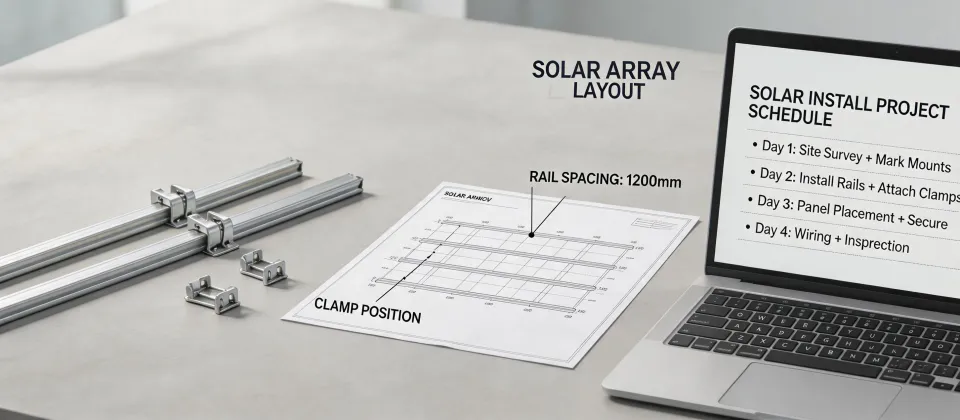
A quick note before the seriousness: if you searched for “gun mounting systems” or “sbaoh portable power station how to charge,” this isn't that article. You're welcome to stay, but this is about solar racking—specifically wholesale metal sheet roof mounting systems. If you run a solar panel installation business, this might save you a headache.
I handle mounting-system orders for a living. I've been doing it for eight years, and I've personally made and documented $64,000 worth of avoidable mistakes. Not because the products were bad. Because I treated them like products.
In March 2022, I approved a quote for a 30kWh solar system on a metal sheet roof. The order total was $4,600. The rework cost was $1,900, plus a week of delays. The contractor's crew left the site, came back, shimmed every clamp, and left again. The mounting system wasn't the problem. The problem was that nobody asked the right question before ordering.
You Probably Think the Problem Is Price
When an installation business complains about mounting systems, it usually starts with price. A quote is too high. A rail is overpriced. Someone else sells the same clamp for less. I get it. I used to think that too. My first year, I chose the lowest-priced rail I could find for a warehouse job. The rail was fine. The freight bill wasn't. The delivery window wasn't. The total cost was higher than the quote I thought was too expensive.
So what's really going on? It's not the hardware. It's the gap between a quote and an installation.
What I Got Wrong About Mounting Systems
My initial approach was completely wrong. I thought if the part numbers matched, the order was correct. Parts arrived, crews installed, and everything worked. Until it didn't. Then the problem wasn't a bad product. It was a mismatch between what was quoted and what was on the roof.
The quote is a price, not a plan
A wholesale quote gives you line items: rail lengths, clamp quantities, end caps, fasteners. It doesn't give you the seam spacing of the metal roof. It doesn't tell you whether the clamp opening matches the solar panel frame height. It doesn't tell you if the system is rated for wind uplift on a building of that height. And it definitely doesn't tell you what happens when the rails are 30 feet up and the clamps are 4 millimeters too narrow.
That 4-millimeter mistake cost us $450 in shims, a day of labor, and one very patient contractor. Not great. Not terrible. But unnecessary.
Small orders get the silent treatment
A 30kWh solar system is a small commercial or large residential project. For a wholesale supplier, it's often a small order. Some suppliers treat small orders like a favor. They don't ask about roof profile. They don't call to confirm the panel model. They ship when it's convenient. If something doesn't fit, they say to measure next time.
I have mixed feelings about this. On one hand, I understand the operational reality. A sales rep with a $500,000 utility-scale project in front of them doesn't always prioritize a $1,500 bracket order. On the other hand, the vendors who took my small orders seriously when I was starting out are the ones I still call today. Small doesn't mean unimportant. Sometimes it means the beginning of a bigger relationship.
That's why our team has a rule now: no order too small for basic engineering questions.
Compatibility is a context, not a spec sheet
Here's something vendors won't tell you: compatible is not a universal claim. A clamp that works with a 30mm frame may not work with a 38mm frame. A rail profile that fits one standing seam may not fit another. The solar industry is built on standardized parts, but the space between standard parts is where mistakes hide.
The last time I didn't verify, we sent 62 clamps with the wrong opening width. Every single clamp went on straight, but only after the installer added shims. The shims cost $450. The embarrassment cost more.
The Real Cost of a “Commodity” Mounting System
Here's the thing: the mounting system is usually 10-20% of a project's total material cost. If you're building a 30kWh solar system, the racking might be $3,500 out of a $30,000 install. The mistake from that March 2022 order—$1,900 in rework—was more than half the racking cost. All because nobody asked about the roof profile before ordering.
Let's put it in perspective. I've documented $64,000 in wasted budget over eight years. That doesn't include the soft costs: the crews waiting on the roof, the angry phone calls, the customers who decided solar was too much trouble. The commercial cost of a failed mounting system isn't just the product. It's the labor, the delay, the trust, and the reputation. Note to self: I still read every quote like it includes free engineering. It doesn't.
A lesson learned the hard way: the cheapest quote is rarely the cheapest project. And the most expensive quote is rarely the most expensive project. The most expensive project is the one that arrives incomplete, incompatible, or too late.
The Solution Is Almost Embarrassingly Simple
After the third costly mistake in Q1 2024, I built a pre-order checklist. It isn't fancy. Four questions:
- What is the exact roof profile and seam spacing?
- What panel model, frame height, and dimensions are being installed?
- What is the wind exposure and building height?
- Where is the delivery going, and when does the crew actually need it?
That's it. No 40-point QC manual. No software subscription. Just four questions that should be answered before anyone talks pricing.
In the 18 months since I started using this checklist, our team has caught 47 potential errors. Most were small—a wrong end cap, a fastener length that was 10mm short, a panel frame height that needed a different clamp. Some were big. One order would have shipped 18 rails that didn't match the available roof area. We caught it because the installer told us the exact building dimensions instead of just asking for a standard kit.
Look, I'm not saying mounting systems are always easy. They're not. There are real engineering decisions in every project. But the typical mistake isn't a design failure. It's a communication failure. The information exists. The question is whether your supplier bothers to ask.
If you run a solar panel installation business, you don't need a better mounting system. You need a supplier who treats the first order like it matters, even when it's small. Because today's small order is tomorrow's utility-scale project. And the supplier who took your $1,500 order seriously is the one you'll call for the $150,000 one.

Renata Silva
Renata Silva is a photovoltaic module analyst covering monocrystalline solar panels, bifacial modules, TOPCon and heterojunction designs, glass-glass construction, junction boxes, and module warranties. She interprets IEC 61215 and IEC 61730 evidence while comparing rated power, conversion efficiency, temperature coefficient, bifaciality, insulation, mechanical-load results, degradation assumptions, and tolerance. Her technical guides help EPC engineers, distributors, and project buyers separate qualification evidence from site-specific energy yield, climate exposure, installation constraints, and long-term performance risk.