Pricing a Wind, Solar and Heat Pump Hybrid: The 7-Step Cost Checklist I Use as a Procurement Manager
2026-09-03 / Renata Silva
-
The 7-Step Cost Checklist
-
Step 1: Start with the load profile, not with the hardware
-
Step 2: Compare cost per delivered kWh, not cost per installed watt
-
Step 3: Add the full balance-of-system before celebrating the headline price
-
Step 4: Match the production curve to the consumption curve
-
Step 5: Put real numbers on permits, grid connections, and site work
-
Step 6: Put recurring and replacement costs into a 10-year operating line
-
Step 7: Require an itemized quote, and be suspicious of package prices
-
Step 1: Start with the load profile, not with the hardware
-
After the Quote: Three Checks I Always Do
I've been the procurement manager at a 40-person renewables integrator since 2019. That means I own the equipment budget, roughly $2.4 million per year, and I've negotiated with more than 75 vendors across solar, wind, and heat-pump technology. When someone sends me a quote that combines PV panels with a heat pump and a wind turbine, I don't do the math in my head. I run the project through the same seven-step checklist I've used for the past six years.
This article is for installers, EPCs, and building owners who are trying to price a hybrid system without guessing. If you're evaluating a vertical wind power generator, a horizontal wind turbine, solar panels, or a domestic hot water heat pump, the steps below will keep the real costs visible. It's not the only way to evaluate a project, but it's the one I trust after getting burned more than once.
The 7-Step Cost Checklist
Step 1: Start with the load profile, not with the hardware
If you've ever priced a system before seeing twelve months of utility data, you know how that ends. Your consultant guesses the solar size, oversizes the heat pump, and finds out later that the domestic hot water load was a third of what the sales sheet assumed.
For every project, I need three numbers: total monthly kWh for a full year, peak kW demand, and the time of day when hot water is used. Why the third? A domestic hot water heat pump can shift its heating into off-peak hours. An air source heat pump heating a whole building either pushes usage up in the morning or it doesn't. If you don't know that pattern, you can't size PV or storage correctly, and every later step is cosmetic.
Step 2: Compare cost per delivered kWh, not cost per installed watt
There's a simple trap in comparing solar and wind: solar is priced in dollars per watt, and wind turbines are often rated by rotor diameter or generator size. You need one unit. I use estimated cost per delivered kWh over ten years, before incentives.
Here's a realistic example from quotes I compared in January 2025. A 5 kW PV system at about $2.80/W installed came to $14,000. In a mid-Atlantic location, it might produce 6,500 kWh in year one. That works out to roughly $0.22 per kWh over ten years before degradation. A 3 kW vertical wind power generator at that same site was quoted at $13,500. With a realistic capacity factor of 0.12, it produces about 3,150 kWh a year, so the cost is closer to $0.43 per kWh. The classic horizontal wind turbine, with the three-blade design, can do better in a genuinely windy site but usually costs more to install. And it will not automatically beat PV on a roof with good sun.
The point is not that wind is always more expensive. It's that comparing $/watt hides a 2x difference in output. Put every option on the same per-kWh basis before discussing whether the client likes the way turbines look.
One note: small-wind output depends heavily on average wind speed. If someone quotes a vertical-axis generator using a 15 m/s wind speed, ask for the average wind speed at hub height at the actual site. The quote should be based on that, not on marketing numbers.
Step 3: Add the full balance-of-system before celebrating the headline price
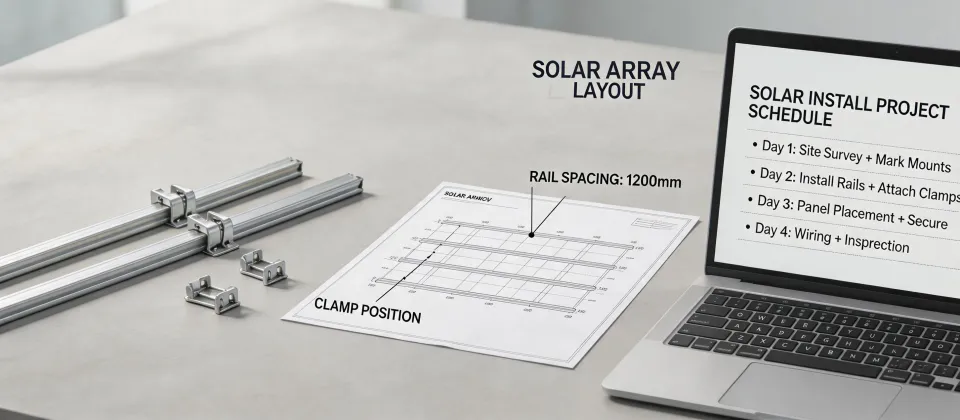
A low PV panel price doesn't matter if the mounting system, rails, clamps, cables, surge protection, and trenching make the total 25% higher. I've seen this happen in at least a third of the early-stage quotes that cross my desk.
When I audited our 2023 project spending, I found that most budget overruns didn't come from the inverter or the panels. They came from parts that weren't listed on the first page: ballast for a flat roof, rail lengths, grounding lugs, wind turbine charge controllers, grid-tie inverters with MPPT inputs plus a wind input, disconnects, conduit, and the electrician's time to connect the heat pump's electrical supply. Add all of that to a spreadsheet before you compare vendors.
Step 4: Match the production curve to the consumption curve
This is the step most people skip, and it usually costs thousands.
Selling solar panels and air source heat pumps together makes sense on paper: solar generation is clean, and heat pumps are efficient. But solar production peaks between 10 a.m. and 3 p.m., while an air source heat pump uses the most power in the morning and evening. In winter, solar output in many regions is at its lowest when heat demand is at its highest.
The workaround is thermal storage. A domestic hot water heat pump is actually a good candidate because it can heat water during the solar peak and store it. But the cylinder volume matters: a small tank will fill by noon, and the rest of the PV energy goes to the grid at export rates while the building buys it back at night. I've seen projects where the owner installed a heat pump water heater and then discovered the immersion heater was doing the real work after sunset.
Ask one question during the design: of the PV energy we generate, how many kWh can actually be used on site at the moment they're produced? If the answer is below 60%, your hybrid system will be less attractive than a boring load-shift schedule on its own.
Step 5: Put real numbers on permits, grid connections, and site work
A domestic hot water heat pump can sit in a garage. A vertical wind power generator cannot, and if the drawing says otherwise, ignore the drawing. Every turbine needs a foundation, a mast, setbacks, and usually a building permit. PV on a pitched roof requires a structural check. Heat pumps need space for outdoor units, condensate drainage, and often an upgraded electrical panel.
These costs are not a rounding error. I've seen grid connection fees add $800 to $3,500, and structural engineering from $500 to $2,000. One resort project in 2024 ended up $8,400 over the equipment-only budget because nobody budgeted for the concrete pad and crane for the turbine. That's not a problem with the technology. It's a problem with the checklist.
Step 6: Put recurring and replacement costs into a 10-year operating line
Procurement people know this, but project developers often ignore it. The cheapest quote can be the most expensive if the inverter dies in year nine, the vertical-axis turbine needs new bearings in year six, or the heat pump maintenance contract costs more than the energy savings.
The items I always add:
- Inverter replacement, usually in years 10 to 12. Budget 20 to 30% of the original electrical cost.
- Annual maintenance for wind turbines: bearings, blades, torque checks.
- Heat pump service: filters, refrigerant checks, and backup heater testing.
- Monitoring subscriptions for PV inverters, heat pumps, or battery systems.
- Cleaning if the array is in a dusty area. It's not optional.
Putting these in the first financial model changes the payback period. It also makes the comparison between a wind horizontal turbine and a vertical wind power generator far more honest, because vertical-axis machines often have maintenance costs that the brochure doesn't mention.
Step 7: Require an itemized quote, and be suspicious of package prices
The worst purchasing mistake I've made was accepting a lump-sum package price for what looked like the same system. It wasn't. The winning vendor had lower prices but omitted the gateway, the electrical isolation equipment, and commissioning.
The policy at our company is simple: every quote above $5,000 must list each major component, each line item of labor, and the warranty terms. We compare apples to apples, line by line. If a supplier says that's included in a bundle, I ask them to unbundle it. If they resist, I suspect they don't want me to see where the margin is. Note to self: this rule has saved more money than all the negotiation training I've attended.
After the Quote: Three Checks I Always Do
1. Apply a 10% contingency. In a 2023 audit, 14% of our completed projects had a budget overrun above 10%, and the cause was always site conditions or missing components, not hardware cost. So we add 10% contingency to every new technology the team has installed fewer than five times.
2. Check labor assumptions. Installation and electrical labor can run 20 to 35% of project cost. That's easy to overlook when the equipment list dominates the spreadsheet.
3. Confirm meter and export rules. Is the site allowed to export? Are there time-of-use tariffs? This matters more in 2025 than it did in 2020, because grid rules have changed in several states.
The fundamentals haven't changed. You buy energy that matches the load, and you measure all of it in delivered kilowatt-hours. What has changed is the catalog. Five years ago, a PV-T panel or a variable-speed domestic hot water heat pump was borderline exotic. Now they appear on routine quotes, and so do small vertical wind machines that claim to be simple. The new options are usually good news. They also mean that when you skip the seven-step math, there are more ways to overspend.
Prices in this article come from quotes I reviewed between December 2024 and January 2025. The market changes quickly, so verify current equipment prices and incentives before putting a final number in a proposal.

Renata Silva
Renata Silva is a photovoltaic module analyst covering monocrystalline solar panels, bifacial modules, TOPCon and heterojunction designs, glass-glass construction, junction boxes, and module warranties. She interprets IEC 61215 and IEC 61730 evidence while comparing rated power, conversion efficiency, temperature coefficient, bifaciality, insulation, mechanical-load results, degradation assumptions, and tolerance. Her technical guides help EPC engineers, distributors, and project buyers separate qualification evidence from site-specific energy yield, climate exposure, installation constraints, and long-term performance risk.