Solar PV Mounting Systems Market and Product Resources: An Urgent-Installation Field Guide
2026-08-20 / Renata Silva
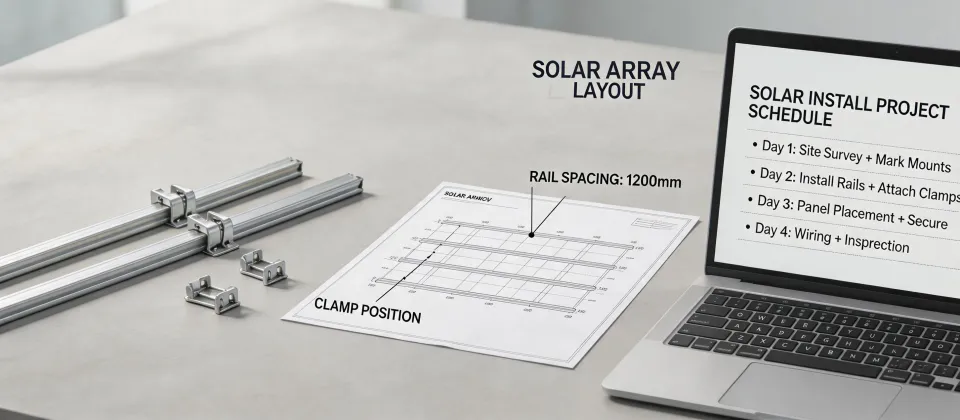
I've spent the last six years on the receiving end of emergency calls at Mounting Systems. The voice on the other end is usually a distributor, an EPC project manager, or a solar installer who just found out the racking won't arrive before the crew does.
The solar PV mounting systems market has matured. Product categories are fairly stable: flat roof, pitched roof, ground, carport. But the decision process hasn't. There is no single 'best' mounting system. There is a best system for your deadline, your roof condition, your wind/snow loads, and your local jurisdiction.
This guide is structured the way I think when a rush order lands: scenario first, product recommendation second. By the end, you should know which scenario you're in—and what to ask for before the next phone call.
Most buyers focus on module price per watt and completely miss the mounting system's documentation. If the load tables or stamped drawings don't match your jurisdiction, the permit stalls—and the deadline is gone.
The Question Isn't 'What's Best?' It's 'What's the Critical Path?'
The question everyone asks is 'Which mounting system is strongest?' The question they should ask is 'What's the critical path on my project?' If the racking lead time is the longest component, you need a different system than if the foundation is the long pole.
Why does this matter? Because in the solar PV mounting systems market, the hardware is usually not the bottleneck. Documentation is. Approval is. Electrical compatibility is. A rail is a rail until the structural engineer won't stamp it.
Four Scenarios, One Critical Path
Scenario A: Commercial flat roof, deadline in days
This is the scenario I handle most. A client has 36 hours before a crane rental, or an end-of-quarter must-hit date, or a tax credit deadline. The temptation is to order a custom ballasted system with exact calculations for every zone. Don't. If you don't have the structural report already, you won't get one in 36 hours.
What works: choose a system with pre-calculated ballast tables for your wind category and roof type, verify it has UL 2703 documentation, and order components from stock. In March 2024, we helped a contractor turn around a 112 kW flat-roof system in a weekend because we used a pre-stamped ballast layout instead of waiting on an engineer. Missing that window would have meant a $50,000 penalty clause in his lease agreement.
So glad we did a second load check on that one. Almost submitted it with the wrong snow load zone—one click away from a permit rejection that would have killed the whole weekend.
Scenario B: Ground mount or carport, civil work leads
Ground-mount projects don't usually need a same-day racking decision. The critical path is grading, foundation, or trenching. Still, people call us when they realize their racking order needs six weeks of lead time and the civil contractor is already on site.
Here's the anti-intuitive part: don't pick the racking with the fastest shipping. Pick the one with the most common components in your region. On a ground mount, a one-day delay on a single bracket can be worse than a week of supplier lead time. If the structural steel is available locally, the project stays alive while you chase the rest.
Scenario C: Residential retrofit, roof condition unknown
The cheapest mounting system on paper can become the most expensive if the roof isn't what the satellite image suggested. I once said 'roof type?' on a call, and the client heard 'solar quote?' and answered with their budget. We didn't learn until the site visit that it was a tile roof with a 35-degree pitch and no walkway.
For this scenario, I'd rather sell a system with adjustable tilt brackets and easy flashing customization than a low-profile system that only works on clean asphalt shingles. If the roof is in poor shape, re-roofing might be the critical path—and no mounting system fixes that.
Scenario D: Emergency repair of an existing PV system
This is different from a new install. The mounting system is already up; the issue is an inverter fault, a failed surge protector, or a battery storage component that won't communicate. The racking matters less than electrical compatibility. Ask for UL 1741 on the inverter, UL 2703 on the racking, and a clear commissioning sequence.
What Good Solar Mounting Systems Product Resources Look Like
If you're shopping under time pressure, the supplier's resources matter as much as the price. The best solar mounting systems product resources are load tables, editable CAD/DWG files, BIM components, installation videos, and compatibility checkers. If the product page says 'contact us for drawings,' add a day to every decision. If it has a spec sheet but no installation manual, assume the installation will take longer than planned.
When I'm triaging a rush order, I look at the documentation first. If they can't show UL 2703 certification and engineering tables in the first email, they're not ready for a fast project.
How to Use Smart Meter Display (and Why It Belongs in a Mounting-Systems Guide)
Once the mounting is up and the inverter is fed, the part people ignore is the smart meter display. Think of it as the hemodynamic monitoring system for your solar installation: it tells you whether AC current is actually flowing, in which direction, and at what rate. If something is blocked, you need to see it before the next utility bill arrives.
How to use smart meter display in practice:
- Find the export/import reading. On most smart meters, you'll see two numbers. The export number should rise when the solar system is generating, and the import number should fall during daylight hours.
- If export stays at zero while the inverter says 'running,' check the CT sensors. We had a 200 kW project in July 2023 where the system was producing the whole time; the only problem was that the meter's CT clamps were on the wrong side of the tie-in.
- Use the display as a first-line diagnostic. If it shows no flow but the inverter shows voltage, the issue is likely wiring or protection, not solar resource.
I knew I should have checked the CT sensor placement before commissioning. But I thought 'standard installs always have it right.' That was the one time it wasn't. Two clamps swapped, and the meter read correctly.
The 'Power Inverter Car Adapter' Test
One insider test: if a quote includes a power inverter car adapter as a standard accessory for a grid-tied rooftop project, ask why. A car adapter is for battery-based or RV systems; it is not a BOS component for a commercial solar inverter. It's a sign that the provider is padding the package instead of thinking about your actual system. That kind of detail tells you how they'll behave when a rush order hits.
How to Tell Which Scenario You're In
Here's a quick decision aid:
- If your deadline is driven by racking delivery and the structural report already exists, you're Scenario A. Prioritize stock availability and pre-calculated ballast tables.
- If the deadline is driven by civil/foundation work, you're Scenario B. Choose locally available components over the fastest quoted shipping.
- If you haven't been on the roof yet, you're Scenario C. The mounting system is not your main problem; the roof survey is.
- If the panels are already up and the inverter/monitoring is failing, you're Scenario D. Stop thinking about racking and focus on electrical compatibility and startup sequence.
Final Word: An Honest Limitation
Look, I am not saying every project needs a full mounting system from a global supplier. If you're building a small off-grid or temporary ground array and you have a structural engineer in the family, a simpler system might work. If your roof is old slate, the right answer might be a ground mount instead of taking the roof apart. We will not push a flat-roof system on a roof that doesn't want it.
Our goal at Mounting Systems is to have the engineering packages ready so that when you need a fast answer, you can get an informed one. If you're in Scenario B or C, slow down. If you're in Scenario A or D, move fast, but ask the right questions: UL 2703, stamped drawings, stock availability, and the exact function of every accessory in the quote.

Renata Silva
Renata Silva is a photovoltaic module analyst covering monocrystalline solar panels, bifacial modules, TOPCon and heterojunction designs, glass-glass construction, junction boxes, and module warranties. She interprets IEC 61215 and IEC 61730 evidence while comparing rated power, conversion efficiency, temperature coefficient, bifaciality, insulation, mechanical-load results, degradation assumptions, and tolerance. Her technical guides help EPC engineers, distributors, and project buyers separate qualification evidence from site-specific energy yield, climate exposure, installation constraints, and long-term performance risk.